Showing posts with label Alhurra. Show all posts

Tuesday, March 1, 2011

African government reaction to events in Libya


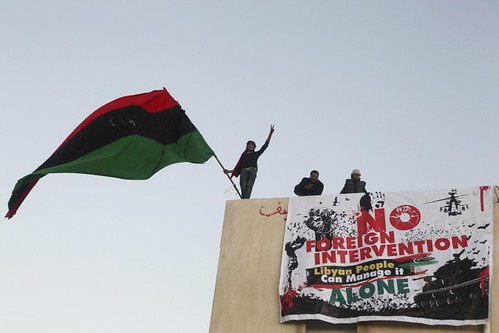
"Hands Off Libya! Libyan people can manage it alone!" Photo by Al Jazzera/Flickr.

Al-Hurra Arabic-language television invited me today to comment on African government reactions to events in Libya.

The interviewer was actually much more interested in the role of African mercenaries than African governments. After commenting that there clearly are some African mercenaries fighting for Colonel Qadhafi, I suggested the accounts are probably exaggerated and we will not have a good idea of the numbers involved until after the conflict is over. More important than the number in Libya today is whether new mercenaries are arriving. There are unconfirmed reports that the government of Zimbabwe has allowed members of its military forces to go to Libya as mercenaries. When members of parliament asked Zimbabwe Defense Minister Emmerson Mnangagwa about these reports, he did not respond directly to the question.

What I really wanted to talk about was the role of African governments. I was able to make a few of the following points:
  • Most of Africa's 53 governments have been silent on events in Libya. Some are concerned that if they criticize Qadhafi, it may endanger their nationals who have not been able to get out of Libya. Certain authoritarian governments are probably reluctant to speak out for fear that such statements will only encourage reformers in their own countries.
  • The response from those African governments that have commented on Libya runs the spectrum from concern to the breaking of diplomatic relations. Senior officials in Mauritania, Morocco, South Africa, Lesotho and Sudan have expressed concern or deep regret about the violence in Libya. The governments of Liberia and Mozambique condemned the violence. The president of Gambia called on Qadhafi to step down immediately. Botswana not only condemned the violence but broke diplomatic relations with Libya.
  • The position of the African Union (AU) has been especially disappointing. So far, it has taken no action. Qadhafi has been a major financial supporter of the AU and this fact may reflect its failure to respond. Should Qadhafi survive, the AU may be concerned that he will cut off future funding. The current AU Chairman is Equatorial Guinea's Teodoro Obiang Nguema Mbasogo, not an African leader at the forefront of political reform. While the Arab League has suspended Libya's membership, the AU dithers.
  • Finally, it will be interesting to see what happens to Qadhafi's Community of Sahel-Saharan States (CEN-SAD). At last count it had 29 African members and has the stated goal of strengthening peace, security, stability and economic development among member states. It is also Qadhafi's effort to create an organization that he hoped would lead one day to the United States of Africa. That concept never had much traction; it has now probably slipped into the ditch.

Thursday, May 27, 2010

Nile water: Down stream versus upstream countries

The Arabic-language Al Hurra TV program based in the United States asked me to join a one-hour panel discussion May 26 concerning recent tension between upstream and downstream countries that constitute the Nile Basin.

Two of the other panelists represented the interests of Egypt and Sudan and a third was an Arabic-speaking journalist from Tanzania based in Cairo. As the only non-Arabic speaking person on the panel and not from the region, I tried to take an academic approach to this controversial issue.


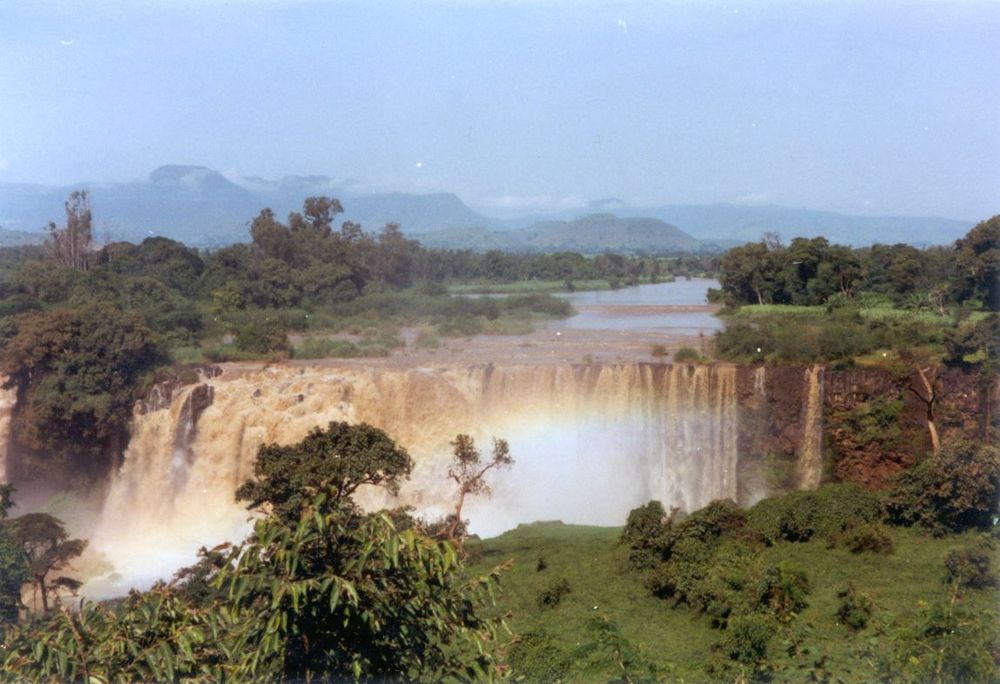
Blue Nile Falls, near Bahar Dar, Ethiopia. Flickr, creative commons licensed, by user mK_B.

Five of the Nile Basin riparian states (Ethiopia, Rwanda, Uganda, Tanzania and Kenya) recently signed a new Nile Basin framework agreement aimed at gaining more legal access to Nile water. Several other upstream countries are expected to sign. Downstream Egypt and Sudan strongly oppose this agreement.

Those two states signed an agreement in 1959 that effectively divided the flow of Nile water 75 percent for Egypt and 25 percent for Sudan, even though 86 percent of the water originates in Ethiopia. None of the other Nile Basin countries signed the 1959 agreement; only Ethiopia was independent at the time. Egypt and Sudan do not want to see any change in the water allocation designated in the 1959 agreement. The upstream states, particularly due to growing population pressures throughout the region, have increasing needs for hydropower and some want to increase irrigated agriculture. Egypt and Sudan see this as a potential threat to their water allocations.

My argument is that upstream hydro dams pose no threat to Egypt and Sudan. The water stops once as it backs up behind the dam and then flows again as before. This is no reason for Egypt and Sudan to get upset.

Large irrigation projects are another matter. They need to be looked at carefully so as not to jeopardize Egypt’s lifeline, the Nile. The same argument applies to a large irrigation project underway in Egypt. There are also ways to improve water usage by better conservation methods in the water sheds and more efficient irrigation techniques than are currently in use. The Nile Basin Initiative has done some excellent work in this area.

Before the current dispute gets out of control, it is useful to remember that the upstream countries have been using water from tributaries feeding into the Nile for many decades. This is not a new issue.

The upstream countries have some legitimate concerns. Ethiopian cities, for example, periodically have no electricity because there is insufficient generating capacity in the country. The downstream countries must take these concerns into account. I have argued for years that the Nile water question is a potential flashpoint in this part of Africa. (See "Avoiding a Water War in the Nile Basin" and "Nile Basin Relations: Egypt, Sudan and Ethiopia.")

Even hysterical rhetoric is not new. Former Egyptian President Anwar el-Sadat stated in 1980 that "If Ethiopia takes any action to block our right to the Nile waters, there will be no alternative for us but to use force. Tampering with the rights of a nation to water is tampering with its life, and a decision to go to war on this score is indisputable in the international community." That statement was made 30 years ago.

There is no need for the Nile water question to result in conflict. I believe that renewed diplomacy and cooler heads will eventually prevail. This current disagreement does underscore, however, the importance of this issue and it will only get worse as the population of the Nile basin area continues to grow at its current rapid rate.

Tuesday, August 4, 2009

Alhurra interview tomorrow

For Arabic-speaking readers, I will be interviewed live by Alhurra TV tomorrow at 2 p.m. for its Al Youm program. The live stream link should be this. The topic will be Secretary of State Hillary Clinton's seven-nation trip to Africa and her meeting with Somalia's transitional government leader Sheikh Sharif Ahmed.

Thursday, July 9, 2009

Interview with Alhurra TV

Alhurra Arabic-language TV asked for my views today on President Obama's upcoming visit to Ghana. I noted that this was actually the President's second visit to Africa as he earlier visited Cairo. He chose Ghana because of the good record it has established in promoting democracy -- four peaceful changes of government in the last 15 years with the opposition winning on two occasions. I suggested that the administration is well engaged on the most pressing crises on the continent. Obama's special envoy for Sudan, Scott Gration, has been active in dealing with problems surrounding both the north-south peace agreement and Darfur. Assistant Secretary of State for African Affairs Johnnie Carson has been active concerning a new U.S. policy towards Somalia, and it is my understanding that there will be a new special envoy for the Great Lakes region of Central Africa as there was in the Clinton administration.