Lawfare posted on 10 May 2020 an analysis titled "China's Balancing Act in Libya" by Frederic Wehrey and Sandy Alkoutami.
China's hesitation to take sides in the Libyan conflict points to a desire to maximize its diplomatic and economic gains irrespective of the ultimate winner. Part of China's strategy has remained consistent. When balancing competing interests, the path of least resistance is most appealing and, often, this is the path of neutrality.
Showing posts with label Muammar Qaddafi. Show all posts
Showing posts with label Muammar Qaddafi. Show all posts
Thursday, May 14, 2020
Tuesday, February 25, 2020
Russian Disinformation Campaigns Target Africa
The Africa Center for Strategic Studies published on 18 February 2020 an analysis titled "Russian Disinformation Campaigns Target Africa: An Interview with Dr. Shelby Grossman."
Russia's Wagner Group has been involved in a long-term disinformation and influence campaign using Facebook aimed at promoting Russian interests. The campaign targeted Cameroon, the CAR, Cote d'Ivoire, DRC, Libya, Madagascar, Mozambique, and Sudan.
Russia's Wagner Group has been involved in a long-term disinformation and influence campaign using Facebook aimed at promoting Russian interests. The campaign targeted Cameroon, the CAR, Cote d'Ivoire, DRC, Libya, Madagascar, Mozambique, and Sudan.

Saturday, July 9, 2011
China-Libya relations
The Mandarin service of the Voice of America asked me to comment on China’s current relationship with Libya.
I explained that prior to the beginning of conflict, China had contracts for $18 billion worth of projects, mostly construction, and 36,000 workers in Libya. In addition, China has become a major importer of Libyan oil.
All of this came to a halt with the outbreak of conflict.
China evacuated its 36,000 workers and has taken significant financial losses on its contracts.
Although China abstained in the UN Security Council on the resolution that allowed NATO to establish a no-fly zone, China has been publicly critical of the way NATO has implemented the policy.
Initially, China had no contact with the Libyan rebels and maintained its embassy in Tripoli. Probably concluding that Qadhafi’s time in power is nearing an end, China initiated contact with the leader of the rebels beginning early in June. That contact continues as China prepares for the day when it may have to deal with a new government in Libya.
The report follows in Mandarin only.
 |
| EXPO 2010, Shanghai, China. Flickr/Dv Yang. |
All of this came to a halt with the outbreak of conflict.
China evacuated its 36,000 workers and has taken significant financial losses on its contracts.
Although China abstained in the UN Security Council on the resolution that allowed NATO to establish a no-fly zone, China has been publicly critical of the way NATO has implemented the policy.
Initially, China had no contact with the Libyan rebels and maintained its embassy in Tripoli. Probably concluding that Qadhafi’s time in power is nearing an end, China initiated contact with the leader of the rebels beginning early in June. That contact continues as China prepares for the day when it may have to deal with a new government in Libya.
The report follows in Mandarin only.
Wednesday, March 30, 2011
"Libya Conflict Could Create Crisis to the South, Analysts Say"
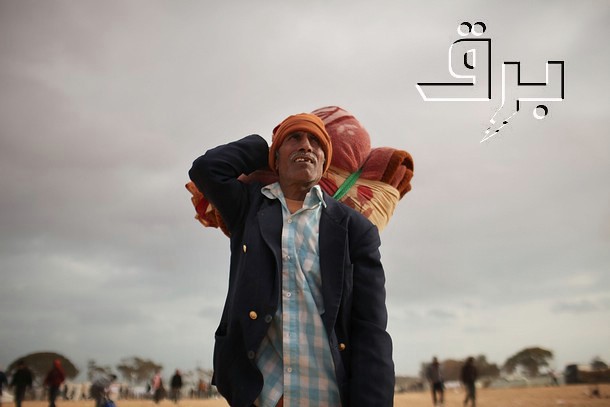
RAS JDIR, TUNISIA - MARCH 08: A man who recently crossed into Tunisia from Libya waits for friends at a United Nations displacement camp on March 08, 2011 in Ras Jdir, Tunisia. As fighting continues in and around the Libyan capital of Tripoli, tens of thousands of guest workers from Egypt, Tunisia, Bangladesh and other countries have fled to the border of Tunisia to escape the violence. The situation has turned into a humanitarian emergency as fledgling Tunisia is overwhelmed with the workers. Libyan leader Muammar Gaddafi has vowed to fight to the end. (Photo by Spencer Platt/Getty Images)
I'm quoted in Drew Hinshaw's Voice of America piece, "Libya Conflict Could Create Crisis to the South, Analysts Say."
Here are the quotes:
Former U.S. ambassador to Ethiopia David Shinn, who says the statistics on mercenaries are overestimated, adds that he is far more concerned about what Africans living and working in Libya will do if they return home.
As many as 20 percent of Libya's five million people are sub-Saharan Africans who traveled overland to find work in this oil-exporting nation.
"Some of them have already left, most I suspect are still there because they can't get out, they're just stuck somewhere. To the extent that they return, they add to the unemployment rolls of whatever country they're coming from," said Shinn.
The economies of those countries, he add may be further damaged by yet a third fallout from the Libyan war.
Gadhafi and his government control billions of dollars of investments across Africa, from hotels, gas stations, a chicken farm in Togo, a telecommunications company in Niger, and several mining companies. Shinn says the finances of these businesses will clearly be in jeopardy if Mr. Gadhafi is driven from power or his regime is badly damaged.
"How Qaddafi's downfall would hurt Libya's southern neighbors"
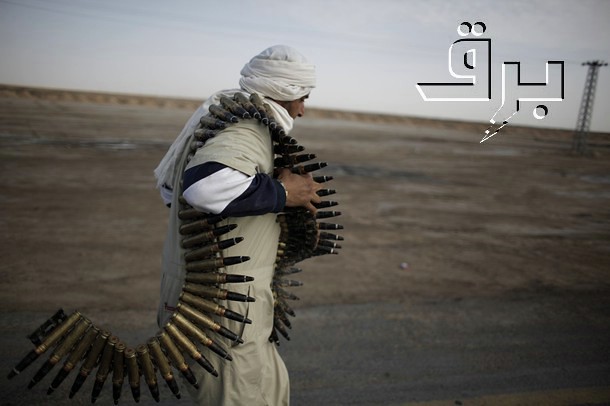
A Libyan rebel soldier carries ammunition as rebel forces prepare for battle in Ajdabiya on March 2, 2011 while pro Moamer Kadhafi soldiers and mercenaries armed with tanks and heavy artillery stormed the nearby city of Brega, 200 kilometres (125 miles) southwest of the main eastern city Benghazi, sparking heavy clashes. MARCO LONGARI/AFP/Getty Images.
I'm quoted in an article by Drew Hinshaw, West Africa correspondent for the Christian Science Monitor, titled "West Africa Rising." Here are my quotes:
More concerning are the mercenaries among the refugees. Estimates of the number of sub-Saharan African soldiers on Qaddafi's payroll range from 300 to a few thousand.
David Shinn, former Ambassador to Ethiopia and Burkina Faso, is less alarmed.
"The whole mercenary thing is significantly overstated," he says. "I suspect we're talking in the hundreds. They are also dispersed over a fairly wide number of countries, which means that in the case of any single country, the only one that would be particularly concerned would be Chad."
"To me," he adds, "the bigger issue is the workforce."
Tuesday, March 8, 2011
"No African red carpet for King of Kings"

"Eritrea has close relations with Gaddafi and Isaias does not seem concerned about the views of his African colleagues," said David Shinn, a former U.S. ambassador to Eritrea's neighbour Ethiopia.Here's the full statement I provided Clarke in response to his questions about where Gaddafi might theoretically seek refuge in Africa if he is forced to flee:
As long as Isaias remains in power, Gaddafi should be safe from any international prosecution.
Much would depend on the circumstances of his departure from Libya. If he left in utter desperation, it is difficult to identify a single African state that would be interested in taking him. In my view, the two most likely candidates would be Zimbabwe and Eritrea. Zimbabwe already has Mengistu Haile Mariam. Eritrea has close relations with Gaddafi and Isaias does not seem concerned about the views of his African colleagues. South Africa would not take him and I can’t imagine that Senegal would do so. Burkina Faso is also an unlikely candidate. Chad and Niger are too close and would be fearful of cross border activity. Equatorial Guinea is an outside possibility, perhaps together with the Comoro Islands. The rest of the world might think of them as island prisons.
Should Gaddafi leave as part of a negotiated arrangement to end or prevent a civil war, then the situation changes. The receiving country could argue that it was doing a favor for all of Africa. In such a situation, possible recipients include Zimbabwe, Eritrea, Equatorial Guinea, Comoro Islands and perhaps a half dozen others. Neighboring countries would not, however, want Gaddafi for fear that it would lead to retribution.
Wednesday, March 2, 2011
"Qaddafi's African Dream in Tatters"
UPDATE 3/9: This story, including my quote, is linked and cited in this Christian Science Monitor piece by Drew Hinshaw.
I'm quoted in Jason McLure's Bloomberg article "Qaddafi's African Dream in Tatters as Net Tightens Around `King of Kings.'"
 Here are my quotes:
I'm quoted in Jason McLure's Bloomberg article "Qaddafi's African Dream in Tatters as Net Tightens Around `King of Kings.'"
“Assuming Qaddafi is finished you’re going to have a very different role that Libya plays whoever is in charge vis-a-vis the rest of sub-Saharan Africa,” David Shinn, a former U.S. ambassador to Burkina Faso and Ethiopia, said in a phone interview from Washington. “Libya will become over the next couple of years a very modest player in African affairs.”Image: Libyan Leader Muammar Qaddafi seen here in 2008. Photographer: Artyom Korotayev/Epsilon/Getty Images.
... Creating the regional group “was his way of providing aid and investment to member nations,” said Shinn. “They saw it as a way of getting largesse out of Libya. I would not be a bit surprised if that organization collapses.”
Tuesday, March 1, 2011
African government reaction to events in Libya
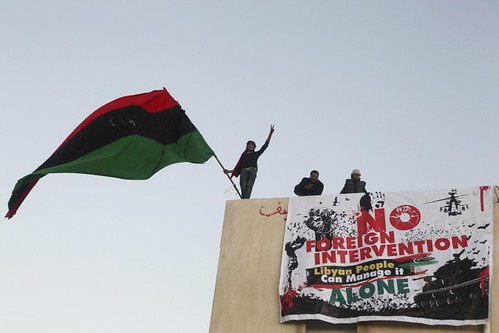
"Hands Off Libya! Libyan people can manage it alone!" Photo by Al Jazzera/Flickr.
Al-Hurra Arabic-language television invited me today to comment on African government reactions to events in Libya.
The interviewer was actually much more interested in the role of African mercenaries than African governments. After commenting that there clearly are some African mercenaries fighting for Colonel Qadhafi, I suggested the accounts are probably exaggerated and we will not have a good idea of the numbers involved until after the conflict is over. More important than the number in Libya today is whether new mercenaries are arriving. There are unconfirmed reports that the government of Zimbabwe has allowed members of its military forces to go to Libya as mercenaries. When members of parliament asked Zimbabwe Defense Minister Emmerson Mnangagwa about these reports, he did not respond directly to the question.
What I really wanted to talk about was the role of African governments. I was able to make a few of the following points:
- Most of Africa's 53 governments have been silent on events in Libya. Some are concerned that if they criticize Qadhafi, it may endanger their nationals who have not been able to get out of Libya. Certain authoritarian governments are probably reluctant to speak out for fear that such statements will only encourage reformers in their own countries.
- The response from those African governments that have commented on Libya runs the spectrum from concern to the breaking of diplomatic relations. Senior officials in Mauritania, Morocco, South Africa, Lesotho and Sudan have expressed concern or deep regret about the violence in Libya. The governments of Liberia and Mozambique condemned the violence. The president of Gambia called on Qadhafi to step down immediately. Botswana not only condemned the violence but broke diplomatic relations with Libya.
- The position of the African Union (AU) has been especially disappointing. So far, it has taken no action. Qadhafi has been a major financial supporter of the AU and this fact may reflect its failure to respond. Should Qadhafi survive, the AU may be concerned that he will cut off future funding. The current AU Chairman is Equatorial Guinea's Teodoro Obiang Nguema Mbasogo, not an African leader at the forefront of political reform. While the Arab League has suspended Libya's membership, the AU dithers.
- Finally, it will be interesting to see what happens to Qadhafi's Community of Sahel-Saharan States (CEN-SAD). At last count it had 29 African members and has the stated goal of strengthening peace, security, stability and economic development among member states. It is also Qadhafi's effort to create an organization that he hoped would lead one day to the United States of Africa. That concept never had much traction; it has now probably slipped into the ditch.
Wednesday, October 27, 2010
Libyan policy in the Horn of Africa
I was invited to give remarks on Libyan policy in the Horn of Africa at a workshop on Libya’s relations with Africa on Oct. 25.
What is striking about Libya’s relations with Ethiopia, Eritrea, Djibouti, and Somalia/Somaliland is the relative lack of economic interaction but a long history of engagement at the political level, especially efforts in the past 10 years to try to resolve, almost always without success, interstate and internal disputes in the region.
In several cases, Libya has been accused of taking sides in interstate disputes, making it difficult to maintain cordial relations with the other party. Since no country in the Horn wants to offend Qaddafi, however, Libya regularly manages to recover from political setbacks.
Libyan Policy in the Horn of Africa
What is striking about Libya’s relations with Ethiopia, Eritrea, Djibouti, and Somalia/Somaliland is the relative lack of economic interaction but a long history of engagement at the political level, especially efforts in the past 10 years to try to resolve, almost always without success, interstate and internal disputes in the region.
In several cases, Libya has been accused of taking sides in interstate disputes, making it difficult to maintain cordial relations with the other party. Since no country in the Horn wants to offend Qaddafi, however, Libya regularly manages to recover from political setbacks.
Libyan Policy in the Horn of Africa
Friday, January 29, 2010
Quote on Libya's Qaddafi in Bloomberg
 I'm quoted in Jason McLure's Bloomberg story "Libya’s Qaddafi May Plunge African Union Summit Into Conflict."
Here's my quote:
I'm quoted in Jason McLure's Bloomberg story "Libya’s Qaddafi May Plunge African Union Summit Into Conflict."
Here's my quote:"I think Qaddafi has had grand ideas from the day he took power in Libya," said David Shinn a former U.S. ambassador to Ethiopia and Burkina Faso, in a Jan. 27 phone interview. "During his incumbency at the African Union I think he continued to propagate those ideas maybe knowing full well they were not going to come to fruition."Image: "Muammar al-Gaddafi pictured at the 12th African Union summit February.02.2009 in Addis Ababa." Flickr Creative Commons-licensed content.
Subscribe to:
Posts (Atom)