Showing posts with label drugs. Show all posts

Wednesday, April 13, 2022

US Navy to Establish New Red Sea Task Force

 Defense News published on 13 April 2022 an article titled "Combined Maritime Forces Establishes New Naval Group to Patrol Red Sea Region" by Megan Eckstein.  

The multinational Combined Maritime Forces in the Middle East will stand up a new Combined Task Force-153 to address maritime threats in the Red Sea and the Gulf of Aden.  The U.S. Navy will lead the task force initially, but will hand leadership over to a regional partner.  At any given time, the task force will consist of two to eight ships, which is not an increase in the present number of ships in the region but an effort to improve coordination and effectiveness.  They will operate from the Suez Canal through the Bab el-Mandeb strait to the Yemen-Oman border and will address human trafficking and smuggling of both legal materials like coal and illegal weapons and drugs.  

Monday, July 9, 2018

Eastern African Seaboard: The Heroin Coast

ENACT published in June 2018 a detailed report titled "The Heroin Coast: A Political Economy along the Eastern African Seaboard" by Simone Haysom, Peter Gastrow, and Mark Shaw.

Africa is experiencing the sharpest increase in heroin use worldwide and a spectrum of criminal networks and political elites in East and southern Africa are substantially enmeshed in the trade. The report focuses on the characteristics of the heroin trade in the region and how it has become embedded in the societies along this route. It also highlights the features of the criminal governance systems that facilitate drug trafficking along this coastal route, particularly in Kenya, Tanzania, Mozambique, and South Africa.

Monday, May 14, 2012

Insecurity in Mauritania

I normally confine this blog to the Horn of Africa, East Africa and China-Africa relations. I have included an analysis of Mauritania because of the high quality of the analysis and the fact that it brings back memories of my assignment to the U.S. embassy in Nouakchott from 1974-1976.

Anouar Boukhars, an assistant professor of international relations at McDaniel College in Maryland, wrote the April 2012 study titled The Drivers of Insecurity in Mauritania for the Carnegie Endowment for International Peace in Washington.

Boukhars reported that the trans-Saharan region is emerging as a hotbed of instability and insecurity. A confluence of forces, from the revolts in North Africa and the proliferation of weapons to transnational trafficking of illicit goods and terrorist activity led by al-Qaeda in the Islamic Maghreb, are generating acute interest in this part of the world.

Mauritania epitomizes the risks that these unstable states with weak capabilities pose to regional and international security. Three stresses emerge as critical to Mauritania's current state of insecurity: the weakness and corruption of state institutions; sociopolitical tensions rooted in old tribal structures and historical ethno-racial divisions; and the growing radicalization of Mauritanian youth.

For Mauritania to break the cycle, the government needs to bolster its anti-corruption initiatives, professionalize its security apparatus, promote social justice, and improve the plight of those at the bottom of the socioeconomic pyramid.

Click here to read the entire analysis.

Wednesday, August 24, 2011

More on Somali piracy

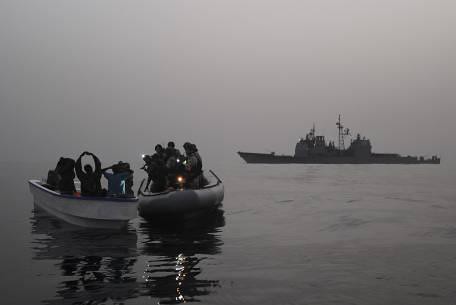
July 22, 2011 : Members of a visit, board, search, and seizure team from the guided-missile cruiser USS Anzio (CG 68), in background, intercept a skiff containing a group of suspected pirates. Anzio is supporting Combined Task Force (CTF) 151, a multi-national, mission-based task force established by the Combined Maritime Forces in January 2009 to conduct counter-piracy operations in the Red Sea, Gulf of Aden, Somali Basin and Arabian Sea. (Combined Maritime Forces photo/Released)
The Swedish Defense Research Agency released a report on piracy in July 2011 by Karl Sorenson titled "Wrong Hands on Deck? Combating Maritime Security in Eastern Africa" (PDF).

The report investigates the threat to maritime security in East Africa and the Horn, responses to deal with these threats and the prospect for building maritime security in the region.

The report argues that in addition to the economic security issue caused by piracy, it is important to consider other illegal activities, such as smuggling of weapons and drugs, illegal fishing, waste dumping and smuggling of humans.