Showing posts with label toxic waste. Show all posts

Friday, December 5, 2025

Will African Countries Stand Up to China?

 The BBC posted on 2 December 2025 an article titled "Devastating Toxic Spill Seen as Test of Whether African Countries Will Stand Up to China" by Mayeni Jones.

The collapse in Zambia of a tailings dam for a Chinese copper mining company resulted in a toxic mess for the local population.  It is now up to the Zambian government to hold the company fully responsible.  This has become a test of how hard Zambia is willing to pressure a company whose government holds $5 billion of its debt.  

Thursday, November 20, 2025

China-Zambia Relations

 The South China Morning Post published on 19 November 2025 an article titled "Railway Deal and a Toxic Spill Likely to Top Agenda as Chinese Premier Visits Zambia" by Jevans Nyabiage.

Chinese Premier Li Qiang will visit Zambia in route to the G20 Summit in Johannesburg, South Africa.  Key issues on the agenda will likely be new funding for rehabilitating the Tanzania-Zambia railway, the aftereffects of a major toxic spill by a Chinese mining company in Zambia, and terms for Zambia's repayment of debt to Chinese banks.  

Wednesday, October 29, 2025

Toxic Spill in Zambia Dogs Chinese Company

 The Wall Street Journal published on 27 October 2025 an article titled "China Pushes to Silence Victims of African Mining Disaster" by Nicholas Bariyo and Stanfrance Zulu.  

The collapse in Zambia early this year of a toxic waste pool at a Chinese copper mine inundated homes and fields downstream and polluted a major river.  Zambian authorities say it will take at least 3 years before the fields can be used to grow crops.  

The Chinese company responsible for the spill is experiencing severe criticism for its handling of the disaster, the amount of compensation offered affected farmers, and an effort to silence any criticism of the company.  

Thursday, May 24, 2018

Improving Security in the Western Indian Ocean

The Institute for Security Studies (ISS) published on 23 May 2018 an analysis titled "From Djibouti to Jeddah, the Western Indian Ocean Needs Security" by Christian Bueger, Cardiff University, and Timothy Walker, ISS.

Twenty littoral countries in southern and eastern Africa and the Arabian Peninsula adopted in 2009 the original Djibouti Code of Conduct that deals with maritime security threats. In 2017, they added the Jeddah Amendments. The guidelines now cover piracy, trafficking of arms and narcotics, illegal wildlife trade, illegal oil bunkering and theft, human trafficking and smuggling, and the illegal dumping of toxic waste. The issue now is how to move from declarations of intent to effective action. In addition, three key states--India, Pakistan and Iran--are not members of the amended Djibouti Code of Conduct.

Thursday, September 13, 2012

Maritime Security in the Indian Ocean

Governments and academics pay too little attention to the important Indian Ocean region, which has major implications for Africa, the Middle East and Asia. The Institute for Security Studies produced a solid paper in August 2012 titled "Maritime Security in the Indian Ocean: Strategic Setting and Features."

I commend it to your attention. Click here to access the paper.

Monday, February 27, 2012

Illegal Fishing and Somali Piracy

The Global Policy Forum, a New York-based independent policy watchdog that monitors the work of the United Nations, released a report on piracy, illegal fishing and toxic waste dumping that will warm the hearts of Somali pirates. It is highly misleading in that it states illegal fishing and toxic waste dumping continue to be serious threats along the shores of Somalia. Illegal fishing was at one time a serious problem along the coast of Somalia. This is undeniable but it largely came to an end about 2005 or 2006 as piracy became a growing threat to all vessels--those operating legally and illegally. This is about the same time that credible source material in the Global Policy Forum study also ends.

Since 2005-2006, most foreign vessels, including fishing vessels, have given wide berth to Somalia's 200 mile economic zone because of piracy. While foreign fishing vessels are still on occasion captured by Somali pirates, they are taken hundreds of miles from the Somali coast, in some cases as much as 1,000 miles. It simply does not pass the common sense test that foreign fishing vessels are continuing to fish the waters within Somalia's 200 mile economic zone. The vessels would be captured and the crew held hostage for ransom. Somali pirates and some Somali officials who benefit from ransom money would like you to believe, of course, that illegal foreign fishing is still occurring within the 200 mile economic zone. The Global Policy Forum should be more careful about buying into this propaganda. At the same time, it is important the international community take steps to help ensure that illegal fishing does not return to the Somali 200 mile economic zone once piracy is brought under control.

Toxic waste dumping is an even more controversial issue than illegal foreign fishing, which clearly did exist in earlier years. There have been a couple of cases that go back about ten years suggesting there was limited toxic waste dumping along the Somali coast. This problem is not limited to the Somali coast. These old reports continue to be replayed as though they happened yesterday. To the best of my knowledge, there have been no recent confirmed cases of toxic waste dumping. This does not mean it has not happened. It just means that it has not been confirmed.

The entire report written by Suzanne Dershowitz and James Paul is dated February 2012 and titled Fisherman, Pirates and Naval Squadrons: The Security Council and the Battle over Somalia's Coastal Seas. You can read it for yourself and make up your own mind.

Wednesday, August 24, 2011

More on Somali piracy

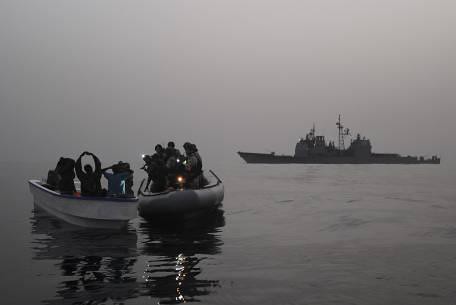
July 22, 2011 : Members of a visit, board, search, and seizure team from the guided-missile cruiser USS Anzio (CG 68), in background, intercept a skiff containing a group of suspected pirates. Anzio is supporting Combined Task Force (CTF) 151, a multi-national, mission-based task force established by the Combined Maritime Forces in January 2009 to conduct counter-piracy operations in the Red Sea, Gulf of Aden, Somali Basin and Arabian Sea. (Combined Maritime Forces photo/Released)
The Swedish Defense Research Agency released a report on piracy in July 2011 by Karl Sorenson titled "Wrong Hands on Deck? Combating Maritime Security in Eastern Africa" (PDF).

The report investigates the threat to maritime security in East Africa and the Horn, responses to deal with these threats and the prospect for building maritime security in the region.

The report argues that in addition to the economic security issue caused by piracy, it is important to consider other illegal activities, such as smuggling of weapons and drugs, illegal fishing, waste dumping and smuggling of humans.

Thursday, December 18, 2008

Three recent interviews on U.S. policy in Africa and Somali pirates

Over the last few days, I was interviewed several times by Voice of America and BBC radio on issues relating to Africa, particularly Somalia. On December 15, I spoke with VOA's Joe de Capua and took a look ahead to the Obama Administration's policies on Africa and what might be carried over from the Bush Administration. I suggested there will be an approach to countering terrorism that relies more on solving root causes and less on a military response. I am told the interview will appear after New Years Day. I also spoke with BBC on the 16th and with VOA radio yesterday on the situation in Somalia. In both cases, I emphasized that the piracy problem will not be completely solved until there is a national government in Somalia that is widely accepted by the Somali people. I expressed doubt that much use will be made of the UN Security Council resolution that permits the international community to pursue pirates on land and suggested some tougher measures for dealing with pirates in the open seas. I also noted that it is important to end illegal fishing and toxic waste dumping in Somali waters by western and Asian ships. UPDATE: The interview with VOA's William Eagle appears here under the heading "Analyst Doubts Effectiveness of UN Crack Down on Somali Pirates."