Showing posts with label Osama bin Laden. Show all posts

Tuesday, October 20, 2020

US to Remove Sudan from List of State Sponsors of Terrorism

 Foreign Policy posted on 18 October 2020 an article titled "Trump to Remove Sudan from Terrorist List, Following Behind-the-scenes Pressure on Israel" by Robbie Grammer.

President Trump announced the US will remove Sudan from the list of state sponsors of terrorism after it agreed to pay $335 million to the families of victims of terrorist attacks on US embassies in Kenya and Tanzania in 1998 and the attack on the USS Cole in Yemen in 2000. 

The Atlantic Council blog posted on 19 October 2020 a commentary titled "Sudan Is Removed from the Terror List. Now What?" by Cameron Hudson.

While this move will do little in the short run to improve Sudan's ailing economy, it is an important political victory for Sudan.  The author argues the US needs to follow up this decision by taking steps that will help ensure a transition to democratic governance in Sudan.

There is an assumption that Sudan will eventually take the controversial decision to recognize Israel, something the US pushed for from the beginning.  

Wednesday, August 26, 2020

Sudan and US Nearing Compensation Agreement

 Foreign Policy published on 25 August 2020 an article titled "U.S. and Sudan Near Pact to Compensate American Terrorism Victims" by Robbie Gramer and Colum Lynch.

Sudan and the US have reportedly reached agreement on compensation of US victims of the terrorist attacks on the US embassies in Kenya and Tanzania in 1998 and the USS Cole in 2000.   

Tuesday, May 19, 2020

US Supreme Court Orders Sudan to Pay Punitive Damages

The New York Times published on 18 May 2020 an article titled "Sudan Must Pay Billions to Terrorism Victims, Supreme Court Rules" by Adam Liptak. 

The U.S. Supreme Court ruled unanimously that Sudan must pay as much as $4.3 billion in punitive damages to victims of the 1998 bombing of American embassies in Kenya and Tanzania.  Sudan's economy is in shambles; it is not clear what will be the practical effect of this ruling.

Monday, April 30, 2018

Background on 1995 Failed Assassination Attempt of Egyptian President

Oxy.com posted on 27 April 2018 a report titled "The Failed Assassination Bid that Ended Al-Qaeda's Stint in Sudan" by Charu Sudan Kasturi.

The article provides background on the attempted assassination in 1995 of Egyptian President Hosni Mubarak while he was attending the Organization of African Unity summit in Addis Ababa, Ethiopia, and the forced departure in 1996 from Sudan of al-Qaeda leader Osama bin Laden.

Thursday, March 10, 2016

Sudan: Legacy of Hassan Al-Turabi

The International Crisis Group published on 10 March 2016 a commentary titled "Hassan al-Turabi's Islamist Legacy in Sudan" by Magnus Taylor. 


Taylor says al-Turabi will be remembered for the role he played in the Islamization of Sudan's laws and the formation of the Popular Arab and Islamic Congress (PAIC).

Friday, May 25, 2012

Al-Qaeda in East Africa and the Horn

A year ago I made a presentation on the history of al-Qaeda in East Africa and the Horn of Africa at a conference sponsored by the Marine Corps University. This presentation now appears as a chapter of a book just released by the Marine Corps University Press titled Al-Qaida after Ten Years of War: A Global Perspective of Successes, Failures, and Prospects edited by Norman Cigar and Stephanie E. Kramer. Additional chapters in the book cover al-Qaeda activities around the world. Click here to access my chapter on "East Africa and the Horn" and all of the chapters in the book.

Monday, June 6, 2011

"Al Qaeda base still strong in East Africa"


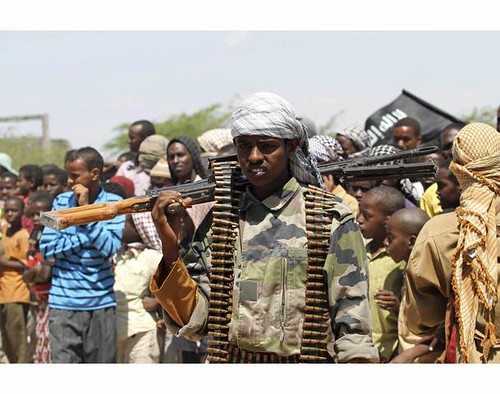
An Islamist al Shabaab soldier at a meeting between al Shabaab and rebel group Hizbul Islam, in southern Mogadishu, January 1, 2011, where the two groups officially merged. Flickr/Abayomi Azikiwe.

I'm quoted in Tristan McConnell's Global Post article, "Al Qaeda base still strong in East Africa: Somalia's Al Shabaab is the most public and active affiliate of Al Qaeda":
“Al Qaeda is a much weaker organization in East Africa today as compared to the mid-1990s,” said David Shinn, adjunct professor of international affairs at George Washington University and a former U.S. ambassador. “In effect, it has been supplanted by Al Shabaab, which has a Somalia-focused agenda.”

Shinn concluded: “I don't think bin Laden's death changes the situation for Al Shabaab.”

Thursday, May 5, 2011

Interview on VOA Straight Talk Africa on the death of Osama bin Laden

Here's more information from the Straight Talk Africa website:

May 04, 2011, Death of Osama bin Laden: Implications for Africa

On Sunday evening, President Barack Obama announced that the United States conducted an operation that killed Osama bin Laden, the world’s most-wanted terrorist since nearly 3,000 people were killed in the terror attacks of September 11, 2001. Mr. bin Laden's al-Qaida terrorist group is also blamed for the bombings of the American embassies in Nairobi, Kenya and in Tanzania's main city Dar es Salaam, which killed over 224 people. The al-Shabab militant group, which controls much of southern Somalia, has close links to al-Qaida and last year carried out a terror bombing in Uganda.

Join us on the next edition of Straight Talk Africa for our live, one-hour television and radio call-in simulcast when guest host Mwamoyo Hamza and his guests take a closer look at Osama bin Laden's death and the war against terrorism around the world and in Africa.

Guests:

Mwamoyo Hamza, VOA Guest Host, VOA Swahili Service Chief

David Gollust, VOA State Department Correspondent, Via Remote: U.S. State Department

Ambassador David Shinn, Former U.S. Ambassador to Ethiopia, George Washington University, Adjunct Professor of International Affairs

Dr. Sulayman S. Nyang, Professor and Chairman of the African Studies Department

The death of Osama bin Laden will probably not have much of an effect on al-Shabaab operations in Somalia

I'm quoted in Reuters east Africa correspondent Richard Lough's story "Bin Laden death will not dampen Somali insurgency." Below is the full quote I provided:


Al-Shabaab is not under the operational control of al-Qaeda but does have close links with it. I think the death of Osama bin Laden will have minimal impact on the al-Shabaab rank and file, nearly all of whom are young Somalis and few of whom are ideologically motivated.

Osama bin Laden was never a major draw for them. The death will have some impact on the leadership of al-Shabaab, about half of which consists of non-Somali foreigners and a small number of Somalis who had a direct connection with the Taliban and/or al-Qaeda. (It is believed there are between 200 and 300 non-Somali foreigners in al-Shabaab; there is a larger number of Somalis with foreign passports from the diaspora.)

Seth Anderson/Flickr
The non-Somali component in particular may begin to question the moorings of the organization and cause it to associate even more heavily with al-Qaeda in the Arabian Peninsula (AQAP). This was a trend well underway before the death of Osama bin Laden.

There is no evidence that al-Shabaab relied significantly on al-Qaeda for funding. It has its own internal sources—taxing, businesses, commerce through the port of Kismayu, etc. Al-Qaeda may have provided some training to al-Shabaab. There conceivably could be a disruption to the extent it was occurring at all.

Nevertheless, the tangible impact on al-Shabaab is likely to be minimal. The psychological impact on the foreigners and small number of Somali jihadists will be greater, but because al-Shabaab is not under the control of al-Qaeda, even this impact may be short-lived.

I doubt that the death of Osama bin Laden will have much of an effect al-Shabaab operations in Somalia. It is currently doing about everything that it is capable of doing. There are few attractive targets in Somalia other than the superior AMISOM forces.

There could be an effort to carry out an attack in a neighboring country— particularly Kenya, Uganda, Ethiopia, or Burundi — along the lines of the bombings in Kampala in July 2010. Al-Shabaab has the capacity to do this. It will have to weigh carefully, however, the response from the source that it might attack.

Following the bombings in Kampala, Uganda increased its troop presence in Mogadishu. Burundi might do the same. Ethiopia and Kenya could send troops deep into al-Shabaab-held territory, although that could be exactly what al-Shabaab would like to see happen. Any al-Shabaab attack beyond the region would be fairly modest in scope because of al-Shabaab’s limited capacity. But its extensive diaspora network does open that possibility.

AMISOM and the TFG have already begun a major offensive against al-Shabaab in Mogadishu and along the Kenya/Somalia border. I doubt there will be much change in activity as a result of the death of Osama bin Laden.

Wednesday, May 4, 2011

"Al-Qaida After 10 Years of War"

The Marine Corps University hosted, as part of the Emerald Express Strategic Symposium Series, a day-long conference in National Harbor, Md., on 26 April, 2011 titled “Al-Qaida after Ten Years of War.”
I gave a presentation on al-Qaida in East Africa and the Horn. There were about 350 persons in the audience, representing the uniformed services, civilians in government, the private sector and universities.

The conference turned out to be especially timely as it occurred only days before the death of Osama bin Laden.

You can listen to the panel session concerning East Africa, the Horn and Asia below, and the transcript appears here (PDF).

Monday, May 11, 2009

Links exist between al Qaeda and al-Shabaab

I was quoted in an article in The Ethiopian Reporter titled "Somalia on track to becoming next Afghanistan" (reprints in Ethiopian Review and Somaliland Press). Here is the brief quote:
David Shinn, former State Department coordinator in Somalia and the U.S. ambassador to Ethiopia from 1996 to 1999, told me that while it’s important to avoid overstating the links between Al Qaeda and al-Shabab, those links do exist.
The passage seems to be taken from my recent interview with Michael Smerconish of The Philadelphia Inquirer. See here for more information, including a transcript of the parts of the interview that did not make it into the article.

Wednesday, April 22, 2009

Quote in Philadelphia Inquirer

Michael Smerconish, radio show host and columnist for The Philadelphia Inquirer, quoted me in his column "Head Strong: Next fight in war on terrorism? Somalia: This is not simply a "piracy" problem. Terrorism - with groups such as al-Shabab - is afoot." Here is the relevant passage:
David Shinn, former State Department coordinator in Somalia and the U.S. ambassador to Ethiopia from 1996 to 1999, told me that while it's important to avoid overstating the links between al-Qaeda and al-Shabab, those links do exist. "There is no question that Islamic extremism in the form of the al-Shabab organization exercises significant influence in Mogadishu and much of southern Somalia," Shinn wrote in an e-mail message. "Although a decentralized organization, it receives external funding and by its own admission has some association with al-Qaeda."
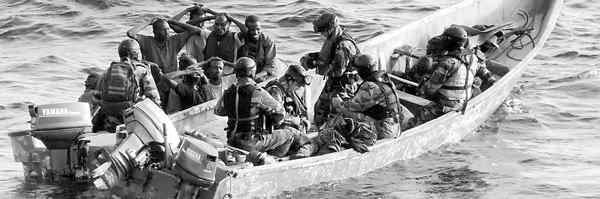
The entire column is accessible here. Image: Suspected pirates (at left) intercepted by French troops off Somalia. The photo was released by the French Defense Ministry earlier this month. ECPAD-FrenchDefense Ministry. UPDATE 4/22: Here are the contents of the interview for the Inquirer article:
Q: What kind of a foothold -- if any -- do you believe Islamic extremists have in the Horn of Africa now? What must the U.S. and international community do to substantively engage the problems we're seeing in that region? A: There is no question that Islamic extremists in the form of the al-Shabaab organization exercise significant influence in Mogadishu and much of southern Somalia. Although a decentralized organization, it receives external funding and by its own admission has some association with al-Qaeda. In fact, it may be claiming a stronger tie to al-Qaeda than is, in fact, the case. There is some evidence of loose and fragile ties between al-Shabab and a few of the Somali pirate organizations. On April 15, two senior al-Shabab leaders praised the pirate attack on the U.S.-flagged Maersk Alabama. Al-Shabab appears to be primarily interested in a connection with some of the pirates for purposes of smuggling arms into Somalia. The pirates are only interested in obtaining ransoms and making money. They do not appear to have any ideological connection with al-Shabab or any terrorist organization. I would not make too much of the al-Shabab-pirate connection, but in some cases they are using each other for their own purposes. Extremists and terrorists have also operated periodically in other parts of the Horn, especially along the Swahili coast of Kenya and during an earlier period in Sudan when Osama Bin Laden was resident there from 1992 until 1996. In the first instance, the United States and the international community must do more behind the scenes to support the moderate Somali government of national unity. A widely-accepted Somali government committed to ending piracy is the only way to eventually end the scourge of piracy and extremist activity in Somalia. In the case of piracy, the international community should recognize that egregious illegal fishing by foreign vessels for many decades has contributed to undermining the Somali economy and help put an end to the illegal fishing until the Somali government is capable of doing so on its own. At the same time, illegal fishing does not justify piracy. Once the country is reasonably secure, the international community will have to increase significantly development assistance to Somalia. In the meantime, it should continue to provide humanitarian aid. Events in Somalia have impacts on the wider region, which, in turn, impacts Somalia. Kenya, Ethiopia, Djibouti, Eritrea, and Sudan all have a key role to play in improving the situation in Somalia. Unfortunately, not all of these countries have consistently made positive contributions. Q: What is the extent of the connection, if any, between al-Shabab and al-Qaeda? A: I cover that in detail in the CTC Sentinel article. A few al-Shabaab members trained in Afghanistan with the Taliban. There are some foreign terrorists who are part of al-Shabaab. But most are young Somali opportunists who have no particular ideological commitment. Al-Shabaab is decentralized with different leaders. A few of them claim close ties to al-Qaeda. There is little proof that the connection is all that close.