Showing posts with label Taliban. Show all posts

Thursday, September 23, 2021

Could Somalia Be the Next Afghanistan?

 Foreign Policy posted on 22 September 2021 a commentary titled "Could Somalia Be the Next Afghanistan?" by Omar S. Mahmood and Abdihakim Ainte.  

Somalia has many similarities to the situation in Afghanistan but there are also important differences.  Without significant changes in Somalia, its path could well mirror the outcome in Afghanistan where the Taliban's success has emboldened al-Shabaab.  

Monday, November 23, 2020

Should the US Try to Negotiate with Al-Shabaab?

 Lawfare posted on 22 November 2020 a commentary titled "No Shortcuts to Negotiating with Al-Shabaab" by Tricia Bacon, American University. 

The author argues there is merit in exploring negotiations with the Al-Qaeda-linked al-Shabaab organization in Somalia even though all past efforts have failed.    

Friday, March 27, 2015

Chinese Foreign Policy Comes of Age

The New York Times published on 26 March 2015 an op-ed titled "Chinese Foreign Policy Comes of Age" by Andrew Small, German Marshall Fund of the United States.  Small concludes that Beijing, long content to sit on the sidelines of security issues beyond its borders, has finally come to see inaction as an even greater risk.  He also applies this new Chinese approach to recent developments in Africa.

Thursday, May 5, 2011

The death of Osama bin Laden will probably not have much of an effect on al-Shabaab operations in Somalia

I'm quoted in Reuters east Africa correspondent Richard Lough's story "Bin Laden death will not dampen Somali insurgency." Below is the full quote I provided:


Al-Shabaab is not under the operational control of al-Qaeda but does have close links with it. I think the death of Osama bin Laden will have minimal impact on the al-Shabaab rank and file, nearly all of whom are young Somalis and few of whom are ideologically motivated.

Osama bin Laden was never a major draw for them. The death will have some impact on the leadership of al-Shabaab, about half of which consists of non-Somali foreigners and a small number of Somalis who had a direct connection with the Taliban and/or al-Qaeda. (It is believed there are between 200 and 300 non-Somali foreigners in al-Shabaab; there is a larger number of Somalis with foreign passports from the diaspora.)

Seth Anderson/Flickr
The non-Somali component in particular may begin to question the moorings of the organization and cause it to associate even more heavily with al-Qaeda in the Arabian Peninsula (AQAP). This was a trend well underway before the death of Osama bin Laden.

There is no evidence that al-Shabaab relied significantly on al-Qaeda for funding. It has its own internal sources—taxing, businesses, commerce through the port of Kismayu, etc. Al-Qaeda may have provided some training to al-Shabaab. There conceivably could be a disruption to the extent it was occurring at all.

Nevertheless, the tangible impact on al-Shabaab is likely to be minimal. The psychological impact on the foreigners and small number of Somali jihadists will be greater, but because al-Shabaab is not under the control of al-Qaeda, even this impact may be short-lived.

I doubt that the death of Osama bin Laden will have much of an effect al-Shabaab operations in Somalia. It is currently doing about everything that it is capable of doing. There are few attractive targets in Somalia other than the superior AMISOM forces.

There could be an effort to carry out an attack in a neighboring country— particularly Kenya, Uganda, Ethiopia, or Burundi — along the lines of the bombings in Kampala in July 2010. Al-Shabaab has the capacity to do this. It will have to weigh carefully, however, the response from the source that it might attack.

Following the bombings in Kampala, Uganda increased its troop presence in Mogadishu. Burundi might do the same. Ethiopia and Kenya could send troops deep into al-Shabaab-held territory, although that could be exactly what al-Shabaab would like to see happen. Any al-Shabaab attack beyond the region would be fairly modest in scope because of al-Shabaab’s limited capacity. But its extensive diaspora network does open that possibility.

AMISOM and the TFG have already begun a major offensive against al-Shabaab in Mogadishu and along the Kenya/Somalia border. I doubt there will be much change in activity as a result of the death of Osama bin Laden.

Monday, March 7, 2011

Al Shabaab's Foreign Threat to Somalia

This article of mine, which appears in Orbis (download it here), is a revised version of a paper delivered at FPRI's annual national security conference, last September, co-sponsored by the Reserve Officers Association in Washington, D.C.

Al Shabaab's Foreign Threat to Somalia by David H. Shinn, former U.S. ambassador to Ethiopia and Burkina Faso

Monday, October 11, 2010

"Americans among insurgent leaders in Somalia"

I'm quoted extensively in Sean D. Naylor's Army Times story. Here's the lede:
Americans occupy senior leadership positions in al-Shabaab, the Islamist insurgent group waging a brutal war in Somalia, according to U.S. Africa Command’s top intelligence officer.

Somalia, which has been without an effective central government for almost 20 years, is “perhaps the ultimate safe haven for Islamic extremists” and “must be a strategic concern for the United States,” said Terrance Ford, AFRICOM’s director of intelligence and knowledge development.

His concern was echoed by Ambassador David Shinn, former State Department director of East Africa and Horn of Africa affairs. Speaking of al-Shabaab, Shinn said: “Its appearance and its organization and the way its leadership is functioning is looking more and more like the Taliban looked back in the 1990s.”

Thursday, October 1, 2009

Quotes in IPS story on Somalia

I'm quoted in Zach Rosenberg's and Jim Lobe's IPS story "President Calls for More Aid in U.S. Visit." Here are the quotes:
While some observers here and at the U.N. were increasingly concerned as recently as three months ago that the TFG was on the verge of collapse, they are expressing more confidence that Sharif's government can hold on, even if it lacks the power to decisively defeat the insurgent groups. "It's a waiting game now," said David Shinn, a Horn of Africa expert at George Washington University who served as ambassador to Ethiopia from 1996 to 1999. "Today, I think the TFG has a pretty good chance of outwaiting Al-Shabaab." ...Sporadic cruise-missile attacks by U.S. forces against suspected al Qaeda and Al-Shabaab leaders during Ethiopia's two-year occupation of Somalia are believed to have contributed to sympathy for the rebels and growing anti-U.S. sentiment in the country in part due to the fact that civilians were also killed injured. Reaction to the last month's attack, however, appeared to be more muted, according to Shinn. "There doesn't seem to have been much blowback in Somalia, perhaps because (Nabhan) was a Kenyan from Yemen," noted Shinn, who added that the attack's precision eliminated collateral damage.

Tuesday, July 7, 2009

9 questions from Life Week (China)

I was interviewed about Somalia by Life Week. You can access the original article in Chinese here, or an English version (via Google Translate) here. Below, I have also included the text of the Q&A, which occurred on June 26. Life Week: The Somali government has declared a state of emergency. How serious is this situation? Amb. Shinn: The situation if very serious. The Transitional Federal Government (TFG) of Somalia, which is recognized by the United Nations, African Union, and Arab League, is being threatened by an extremist organization, al-Shabaab and an allied group known as Hizbul Islam. Al-Shabaab has stated publicly that it has links with al-Qaeda. It has strong external support, including a growing number of foreign jihadis from the Middle East, South Asia, and northeastern Africa. Al-Shabaab and probably Hizbul Islam also receive financing and weapons from outside Somalia. The two groups have seized by force significant parts of Mogadishu, the capital city, and southern and central Somalia. Life Week: The Speaker of Somalia’s Parliament said they were under attack by foreign terrorists. Is it true that some foreign fighters participated in the fight? Why do they do so? Amb. Shinn: Most of the fighters for al-Shabaab and Hizbul Islam are Somalis. They have joined these groups for different reasons. Some believe in the extreme version of Sharia advocated by these organizations while others simply want to seize power. Some have come from the Somali diaspora in Europe, North America, and elsewhere. Some of the fighters are not Somali and have joined the battle in order to impose their extreme interpretation of Sharia on the Somalis. Virtually all Somalis are Muslim; they have traditionally practiced a moderate version of Islam. Life Week: Some people said the foreign fighters and the al-Shabaab have a very close relationship with al-Qaeda. Is that true? Why does al-Qaeda support anti-government forces in Somalia? Amb. Shinn: Many of the foreign fighters almost certainly have links with al-Qaeda and/or the Taliban in Afghanistan. Some of them probably do not have ties with these groups but have been attracted by the radical ideology of al-Shabaab. A few of al-Shabaab’s Somali leaders also have past associations with al-Qaeda and the Taliban. I suspect that most of the Somali rank and file members of al-Shabaab do not have ties with al-Qaeda. Life Week: Some Somali analysts say the conflict between the TFG and al-Shabaab will drag on for months fueled by outside support for both sides. Besides al-Qaeda, what support do both sides receive from the outside? Amb. Shinn: Those Somali analysts are probably correct; the conflict will drag on for months fueled by outside support. Al-Shabaab and Hizbul Islam also receive support from the government of Eritrea, some Somalis in the diaspora, and private non-Somalis in the Middle East and South Asia. The TFG receives humanitarian and moral support from most of the international community, including the United States. Several European countries have provided training to TFG security forces. The U.S. State Department confirmed on June 25 that it has delivered a shipment of arms to the TFG. Somalis in the diaspora also support the TFG. Life Week: Somalia has become an international conflict. How does the unsettled situation in Somalia affect neighboring countries such as Kenya and Ethiopia? Why is Ethiopia so concerned? Amb. Shinn: Somalia shares a lengthy border with both Kenya and Ethiopia. The persons living in those neighboring parts of Kenya and Ethiopia are Somalis. There is a long history whereby past Somali governments have wanted to incorporate those territories into Somalia. This has led to conflict. In the late 1970s, Somalia invaded Ethiopia and occupied most of the Somali-inhabited territory for a number of months. The TFG has disavowed any desire to take control of these territories, but al-Shabaab and Hizbul Islam have not. In fact, a few of their leaders have explicitly raised the possibility of occupying these territories. The borders are very porous; it is not difficult to cross them and carry out attacks on the other side. Kenya is the location of hundreds of thousands of Somali refugees who have fled Somalia because of the unrest there. This puts an additional burden on the government of Kenya, which recently sent additional forces to its border with Somalia. The neighboring countries do have legitimate security concerns, but it is important that they not take actions that will worsen the situation. Life Week: Somalia’s Parliament pleaded Saturday for its neighbors and the international community to send in troops. Will the neighboring countries and the international community take such action? Amb. Shinn: This is a highly controversial issue. First, the African Union has 4,300 Ugandan and Burundi troops in Mogadishu. Their mandate only allows them to protect the TFG’s state house, the port, and airport. They are not permitted to seek out and confront the groups that are trying to overthrow the TFG. Second, the United Nations sponsored a major military intervention in Somalia from 1993 until 1995. It was not a good experience. It did not end Somalia’s failed state, and it alienated a lot of Somalis in the process. Third, Somalis do not like the idea of foreign troops in the country, including the foreign jihadis that support al-Shabaab. The international community would risk alienating Somalis again if it sent troops in support of the TFG. The sending of foreign troops would not, in my view, help the TFG over the long term. At best, it would postpone tough decisions that the TFG must make now. I doubt that the international community will send forces to Somalia. Although the African Union may increase the number of troops it has in Somalia, it will make little military difference so long as the AU mandate is one of static defense. Life Week: Will the U.S. attitude influence the situation? Amb. Shinn: The attitude of all permanent members of the UN Security Council, including the United States and China, in addition to the European Union, African Union, and Arab League will influence the situation in Somalia. It is in the interest of all these governments and organizations to encourage stability in Somalia and to help create a government that has the widespread support of Somalis. Life Week: Why are the anti-TFG groups such as al-Shabaab unwilling to negotiate with the government? What is their claim? Amb. Shinn: Al-Shabaab and Hizbul Islam want power and will do anything they can to achieve their goal including suicide bombings and political assassinations. They have no interest in power sharing. They claim they are trying to force foreign elements out of Somalia while relying increasingly on foreign jihadi fighters for their own support. Life Week: Why has Somalia been unable to achieve political stability since 1991? Amb. Shinn: This question is more appropriately directed to a student writing a dissertation for a doctoral degree. The answer is long and complex. For fear of oversimplifying, it is important to recall that the last national government in Somalia, the one led by Siad Barre, failed completely in 1991. Northwest Somalia declared its independence as Somaliland in 1991 and has actually put in place surprisingly democratic government. The rest of Somalia broke up into fiefdoms led by local administrations such as Puntland or warlords in Mogadishu and parts of southern and central Somalia. The right combination of circumstances and Somali leadership has not yet come together to convince the vast majority of Somalis that they should support that leadership. Somalia also became a proxy war between Ethiopia and Eritrea. Finally, extremists from outside Somalia decided to take advantage of the failed Somali state for their own purposes. This is an oversimplification but probably as much as your readers want to know.

Monday, May 11, 2009

Links exist between al Qaeda and al-Shabaab

I was quoted in an article in The Ethiopian Reporter titled "Somalia on track to becoming next Afghanistan" (reprints in Ethiopian Review and Somaliland Press). Here is the brief quote:
David Shinn, former State Department coordinator in Somalia and the U.S. ambassador to Ethiopia from 1996 to 1999, told me that while it’s important to avoid overstating the links between Al Qaeda and al-Shabab, those links do exist.
The passage seems to be taken from my recent interview with Michael Smerconish of The Philadelphia Inquirer. See here for more information, including a transcript of the parts of the interview that did not make it into the article.

Wednesday, April 22, 2009

Quote in Philadelphia Inquirer

Michael Smerconish, radio show host and columnist for The Philadelphia Inquirer, quoted me in his column "Head Strong: Next fight in war on terrorism? Somalia: This is not simply a "piracy" problem. Terrorism - with groups such as al-Shabab - is afoot." Here is the relevant passage:
David Shinn, former State Department coordinator in Somalia and the U.S. ambassador to Ethiopia from 1996 to 1999, told me that while it's important to avoid overstating the links between al-Qaeda and al-Shabab, those links do exist. "There is no question that Islamic extremism in the form of the al-Shabab organization exercises significant influence in Mogadishu and much of southern Somalia," Shinn wrote in an e-mail message. "Although a decentralized organization, it receives external funding and by its own admission has some association with al-Qaeda."
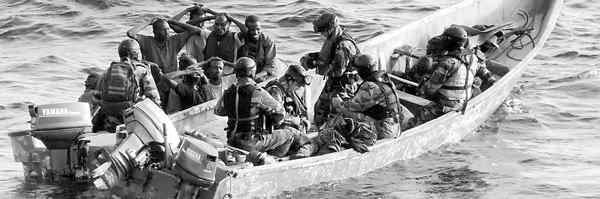
The entire column is accessible here. Image: Suspected pirates (at left) intercepted by French troops off Somalia. The photo was released by the French Defense Ministry earlier this month. ECPAD-FrenchDefense Ministry. UPDATE 4/22: Here are the contents of the interview for the Inquirer article:
Q: What kind of a foothold -- if any -- do you believe Islamic extremists have in the Horn of Africa now? What must the U.S. and international community do to substantively engage the problems we're seeing in that region? A: There is no question that Islamic extremists in the form of the al-Shabaab organization exercise significant influence in Mogadishu and much of southern Somalia. Although a decentralized organization, it receives external funding and by its own admission has some association with al-Qaeda. In fact, it may be claiming a stronger tie to al-Qaeda than is, in fact, the case. There is some evidence of loose and fragile ties between al-Shabab and a few of the Somali pirate organizations. On April 15, two senior al-Shabab leaders praised the pirate attack on the U.S.-flagged Maersk Alabama. Al-Shabab appears to be primarily interested in a connection with some of the pirates for purposes of smuggling arms into Somalia. The pirates are only interested in obtaining ransoms and making money. They do not appear to have any ideological connection with al-Shabab or any terrorist organization. I would not make too much of the al-Shabab-pirate connection, but in some cases they are using each other for their own purposes. Extremists and terrorists have also operated periodically in other parts of the Horn, especially along the Swahili coast of Kenya and during an earlier period in Sudan when Osama Bin Laden was resident there from 1992 until 1996. In the first instance, the United States and the international community must do more behind the scenes to support the moderate Somali government of national unity. A widely-accepted Somali government committed to ending piracy is the only way to eventually end the scourge of piracy and extremist activity in Somalia. In the case of piracy, the international community should recognize that egregious illegal fishing by foreign vessels for many decades has contributed to undermining the Somali economy and help put an end to the illegal fishing until the Somali government is capable of doing so on its own. At the same time, illegal fishing does not justify piracy. Once the country is reasonably secure, the international community will have to increase significantly development assistance to Somalia. In the meantime, it should continue to provide humanitarian aid. Events in Somalia have impacts on the wider region, which, in turn, impacts Somalia. Kenya, Ethiopia, Djibouti, Eritrea, and Sudan all have a key role to play in improving the situation in Somalia. Unfortunately, not all of these countries have consistently made positive contributions. Q: What is the extent of the connection, if any, between al-Shabab and al-Qaeda? A: I cover that in detail in the CTC Sentinel article. A few al-Shabaab members trained in Afghanistan with the Taliban. There are some foreign terrorists who are part of al-Shabaab. But most are young Somali opportunists who have no particular ideological commitment. Al-Shabaab is decentralized with different leaders. A few of them claim close ties to al-Qaeda. There is little proof that the connection is all that close.