UN officials warn that soaring prices of food, fuel, fertilizers, and other commodities due to the Russia-Ukraine war could have a profound destabilizing impact on Africa.
While it stays out of the “land grab” debate, where there is more myth than fact, it documents Chinese FDI in Africa’s agricultural sector.
The paper analyzes the driving factors behind China’s agricultural investment in Africa, particularly from the perspectives of economic development and market factors, and concerns about food security. It considers the implications of China’s experiences in terms of institutions, productivity and technology. Finally, the paper addresses the issues of green technology in the context of China’s agricultural investment in Africa.
The report acknowledges that it is hard to assess the impact of China’s investment in Africa. It is, nevertheless, important to understand why China has accelerated its agricultural investment in Africa, and the extent to which China’s investment has had an impact on African agricultural growth.
The 6 September 2011 report emphasizes that South Sudan is acutely vulnerable to recurring conflict and climatic shocks. The situation is exacerbated by a continuing influx of returnees, restricted movement across the northern border, high fuel prices, and regional shortages of food stocks. South Sudan challenges normal development paradigms and fits awkwardly in the humanitarian relief-recovery-post-conflict development continuum.
The paper highlights ten priority areas for action based on the experience of NGOs operating in South Sudan and lessons learned during the Comprehensive Peace Agreement period. A summary of the recommendations follows:
Balance development assistance with continued support for emergency humanitarian needs.
Understand conflict dynamics.
Involve communities and strengthen civil society.
Ensure an equitable distribution of assistance.
Prioritize the most vulnerable and ensure social protection.
Promote pro-poor, sustainable livelihoods.
Strengthen government capacity, from the bottom up.
Allow sufficient time for transition towards government management of international aid.
Provide timely, predictable funds.
Ensure integrated programming.
For all its value, the report has a glaring omission that casts doubt on its credibility. The overwhelming problem of corruption in South Sudan is talked around, but not met head-on. Unless you read carefully between the lines, you would not know corruption is a problem.
South Sudan has received between $8 and $10 billion in oil revenue. Other than pay salaries to a bloated military and civil service, there is very little to show for this staggering amount of money. This NGO report is essentially a plea for more donor aid, albeit aid administered more effectively. The report should first insist that the government of South Sudan explain what it has done with $8 to $10 billion before calling on the donor community to pump yet more money into the country.
At a minimum, it should highlight the problem of corruption and acknowledge there will be no serious development in South Sudan until corruption is brought under control.
Written by Simon Freemantle and Jeremy Stevens, it reviews China’s growing food security needs, emphasizing that most agricultural imports now come from Asia and the Western Hemisphere. In 2010, for example, the Americas accounted for 99 percent of all soybean exports to China. In 2009, the only agricultural imports from Africa that exceeded 10 percent of China’s total imports were wood, tobacco, oil seeds, and cocoa.
Looking to the future, however, China is expanding its agricultural cooperation with Africa. In 2009, China was conducting about 200 agricultural and 23 fishery projects in Africa.
Although China considered in 2008 a policy of acquiring significant amounts of land in Africa, it has backed away from that idea following criticism that it was seeking to grab African lands. Consequently, China is playing a minimal role today in efforts to lease land in Africa. On the other hand, China is seeking to expand collaboration with African countries in the production of cotton, soybeans, coffee, tea, rubber, wine, sisal, and tobacco.
The Center for American Progress and One Earth Future Foundation issued a report dated September 2011 titled “Twenty Years of Collapse and Counting: The Cost of Failure in Somalia.”
Written by John Norris and Bronwyn Bruton, it estimates that the international community has spent more than $55 billion dealing with crises related to Somalia since 1991. It describes Somalia as “a tragic case study of the international community getting it wrong repeatedly.” It adds that “the United States in particular shows an almost willful disregard for sensible diplomacy or the kinds of patient, grassroots engagement that might have helped Somalia achieve a greater level of stability at different junctures.”
While I agree that the international community and the United States have made more than their share of mistakes in Somalia, I believe the report is excessively harsh on the role of the international community. It was the international community that ended the 1992-1993 famine and has continued to keep many Somalis alive with emergency food aid. In the final analysis, it is Somalis themselves who created this situation. Could the international community done much better? Yes.
The Canadian Broadcasting Corporation and Al Jazeera English asked me to comment Aug. 6 on al-Shabaab's retreat from Mogadishu.
I responded that this is the first time since al-Shabaab took control of most of Mogadishu that it had been completely forced out of the capital.
Al-Shabaab has been losing ground for months to the African Union (AMISOM) force in Mogadishu supplemented by forces from the Somali Transitional Government (TFG). But while al-Shabaab is no longer in the capital, it still controls most of south/central Somalia.
At some point, unless al-Shabaab forces continue to weaken, they will try to return to Mogadishu. This is an opportunity for the TFG but it may not be able to take advantage of the new situation.
The implications of this development are significant for the 100,000 or more Somalis seeking emergency food aid who recently moved into the AMISOM/TFG controlled part of Mogadishu from areas controlled by al-Shabaab. Until several days ago, there was fighting in part of Mogadishu, making it difficult for international relief agencies and Somali non-governmental organizations to feed these internally displaced persons.
With the departure of al-Shabaab, it should be much easier to care for the needs of these Somalis. On the other hand, the removal of al-Shabaab from Mogadishu will not make it any easier to provide food to famine victims in those areas of south and central Somalia still controlled by al-Shabaab. This is where the need is greatest and al-Shabaab continues to impose severe restrictions on the ability of international organizations to operate in territory it controls.
It remains to be seen if this major setback will cause long-term damage for al-Shabaab. There have been fissures among the organization’s leaders for a long time. Al-Shabaab’s mishandling of the drought and famine has exacerbated those divisions. The withdrawal from the capital of Somalia is another blow that may result in even more serious fracturing of the leadership.
I was interviewed on Aug. 3 on Voice of America's Straight Talk Africa, hosted by Shaka Ssali. The other guests were Gabe Joselow, Voice of America's East Africa correspondent, and Abdullahi Abdi, a Somali political analyst.
I was interviewed, along with Jeffrey Gettleman, New York Times East Africa bureau chief, and Mark Bowden, United Nations humanitarian coordinator for Somalia, on WHYY Radio about Somalia by guest host Tracey Matisak.
Here's the blurb:
Somalia – without a functioning government for most of the last 20 years, devastated by civil war and the insurgency of al Qaeda-affiliated Al Shabab, and one of the poorest, most dangerous places in the world – has now endured successive droughts that have exacerbated the humanitarian crisis there, prompting the United Nations to declare a famine in two provinces of Somalia, and it is believed to be spreading throughout the country’s south. As tens of thousands of starving refugees flee across the border to refugee camps in Kenya, Al Shabab continues to threaten and attack Western aid groups it accuses of espionage and worse.
While I do not normally use this blog for solicitations, I am making an exception in the case of Horn Relief.
I have served on the U.S.A. Board of Horn Relief for the past six years and attended the annual board meeting in Nairobi last year. It is a reliable and responsible organization.
In the event that you want to help Somali famine victims, I urge that you consider making your contribution to Horn Relief.
Dear friends and colleagues,
Somalia has been devastated by years of conflict and international isolation. Now it is the location of the first official famine of the 21st Century. There are unsung heroes and organizations who continue to defy the odds but the current stats are staggering and we need your help. Please donate at hornrelief.org. For more info, see below.
Somali refugee camps in Kenya are already busting at the seams with nearly 500,000 living in camps designed for 1/5th of that number. This causes dire public health concerns.
Everyday, right now, 3.7 millions people are devastated by drought and famine.
Horn Relief has been working in Somalia and the Horn of Africa continuously for more than 20 years. Horn Relief is often requested to teach its methodologies and approaches to the UN and across numerous countries.
Our Donors come from all over the world and many Donors have continued to offer financial support and partnership year after year.
Horn Relief uses traditional systems of engaging elders to help with the oversight of programming and distribution of resources for transparency and accountability.
Horn Relief's efficient management practices allow for every $1 you give, 90% goes directly to those in need. The remaining 10% is used for operational costs such as stationary, fuel, and lights to keep the cause going.
We are working to save lives through various emergency programs including; delivery of clean water for humans and livestock, support for agriculture projects, distribution of cash, and cash for work.
$25 will feed a family for 1 week
$100 will feed a family for 1 month
$150 will provide food & basic needs for a family for 1 month
$300 will provide food & basic needs for a family for 2 months
Your financial support is needed to bring emergency food, clean water and other essential care to children and their families in the Horn of Africa.
Thank you for your support and welcome to the Horn Relief network of patrons and donors. Please spread the word!
Respectfully,
Kelley Page Jibrell
USA Chair, Board of Directors for Horn Relief
www.hornrelief.org
Horn Relief and its Founder, Fatima Jibrell, have won the 2002 Goldman Environmental Prize for Africa and the 2008 National Geographic Society/Buffett Foundation Leadership for Conservation Award.
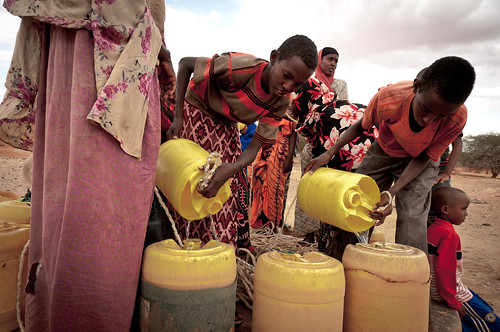
Collecting water in Wajir, Kenya. Pastoralist families have been hit especially hard by drought that is killing livestock on which they depend for milk, meat and income. Colin Crowley/Save the Children
It concludes that the region is facing the worst food crisis of the 21st century. Parts of Ethiopia, Somalia and Kenya are particularly affected. The drought comes on top of a deeper crisis of poverty and marginalization. Oxfam concluded that the international donor response to the crisis has been slow and inadequate.
I was invited to testify on Somalia 7 July, 2011 before the House Subcommittee on Africa, Global Health, and Human Rights and the Subcommittee on Terrorism, Nonproliferation and Trade.
My testimony (which Congressman Chris Smith posted on his site) covered the Obama Administration’s dual track policy, the role of counterterrorism and military strikes, contact with al-Shabaab, piracy, countering drought and potential famine, recognition of Somaliland and regional economic integration.
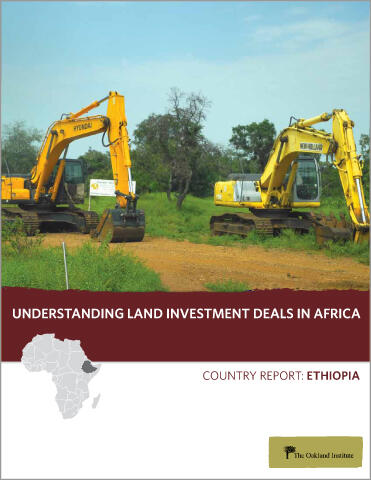
The Oakland Institute was generally critical of government policies followed in signing these deals.
For example, it pointed out there are no mechanisms in place to ensure that these investments contribute to improved food security. There are incentives to ensure that food production is exported from Ethiopia, providing foreign exchange at the expense of adding to local food supply. The agreements do not ensure that local people benefit from the business opportunities that these investments offer.
While large foreign investments grab the headlines, many Ethiopian land deals involve small scale investors, both local and from the Ethiopian diaspora. The vast majority of foreign investors in Ethiopia are private companies, mostly Indian.
The Oakland Institute found evidence that only two countries — Egypt and Djibouti — had invested directly in Ethiopian farmland. Contrary to press reports, China was absent from the land investment deals, although a Chinese company is about to sign the first Chinese land investment in Ethiopia — a 25,000 hectare concession in Gambella region to produce sugarcane.
There has been a heated discussion in recent weeks on the food crisis in the Horn of Africa. There have been charges and counter charges concerning the severity of the crisis.
Writing in The World Today, Roger Middleton briefly and dispassionately summarized the situation in an item titled "Horn of Africa Food Crisis: Perfect Storm." He concluded that climate is the most obvious and immediate cause of the crisis but added conflict and displacement of people have contributed significantly to the problem.
The Voice of America Amharic service asked me to comment today on the dispute between Ethiopian Prime Minister Meles and the food aid organizations concerning the magnitude of current food shortages in Ethiopia. The humanitarian community argues that the need for food is much greater than the prime minister believes is the case.
First, I pointed out that I can not speak to the precise Ethiopian requirement for imported food assistance today. I am too far away from the problem and do not know if the food aid organizations or government of Ethiopia has the best estimate of current food needs.
Second, I suggested that some historical perspective might be helpful. This is not the first time that the government of Ethiopia and the food aid agencies have disagreed on the need for imported food. In the past, the aid agencies generally have had higher estimates for food needs than those recognized by the government. There is some evidence that in the past these organizations have overestimated the need.
In addition, over the past two decades the government has a pretty good record of storing food around the country so that it is possible to avoid famine and significant starvation. This storage system does not eliminate severe or even moderate food shortages, but it does minimize the harm resulting from food shortages.
When asked if Meles reacted so strongly to the reports from the food aid organizations because of the upcoming national elections, I responded in the negative. In my view, elections that will probably take place in May 2010 are too far away to explain the prime minister's strong negative reaction to the reports.
Finally, the VOA asked me to comment on steps that need to be taken to avoid food shortages in the future. I suggested that although Ethiopia has improved its agricultural practices in recent years, there is still much room for more improvement so that the country can produce more food per hectare than it is doing now. This includes more efficient farming practices, more appropriate use and distribution of fertilizer, and use of improved seed. Ethiopia's partners need to help with this effort.
There may be some agricultural policies that require changing. I am not an expert in this area and am not able to suggest specific changes, but agricultural policy needs to be reviewed.
Finally, it is important to lower the population growth rate in Ethiopia. Ethiopia adds between 1.5 million and 2 million persons to its population each year. This requires more food to feed this constantly growing population. A lower population growth rate would make it easier for Ethiopia to feed its own people. I would point out that since the final years of the Haile Selassie government Ethiopia has never produced enough food to feed all of its people. Ethiopia's population in the early 1970s was much smaller than it is today.
Photo: "Meles-cropped" from flickr via creative commons. User: openDemocracy.


 In addition, over the past two decades the government has a pretty good record of storing food around the country so that it is possible to avoid famine and significant starvation. This storage system does not eliminate severe or even moderate food shortages, but it does minimize the harm resulting from food shortages.
When asked if Meles reacted so strongly to the reports from the food aid organizations because of the upcoming national elections, I responded in the negative. In my view, elections that will probably take place in May 2010 are too far away to explain the prime minister's strong negative reaction to the reports.
Finally, the VOA asked me to comment on steps that need to be taken to avoid food shortages in the future. I suggested that although Ethiopia has improved its agricultural practices in recent years, there is still much room for more improvement so that the country can produce more food per hectare than it is doing now. This includes more efficient farming practices, more appropriate use and distribution of fertilizer, and use of improved seed. Ethiopia's partners need to help with this effort.
There may be some agricultural policies that require changing. I am not an expert in this area and am not able to suggest specific changes, but agricultural policy needs to be reviewed.
Finally, it is important to lower the population growth rate in Ethiopia. Ethiopia adds between 1.5 million and 2 million persons to its population each year. This requires more food to feed this constantly growing population. A lower population growth rate would make it easier for Ethiopia to feed its own people. I would point out that since the final years of the Haile Selassie government Ethiopia has never produced enough food to feed all of its people. Ethiopia's population in the early 1970s was much smaller than it is today.
Photo: "Meles-cropped" from flickr via creative commons. User:
In addition, over the past two decades the government has a pretty good record of storing food around the country so that it is possible to avoid famine and significant starvation. This storage system does not eliminate severe or even moderate food shortages, but it does minimize the harm resulting from food shortages.
When asked if Meles reacted so strongly to the reports from the food aid organizations because of the upcoming national elections, I responded in the negative. In my view, elections that will probably take place in May 2010 are too far away to explain the prime minister's strong negative reaction to the reports.
Finally, the VOA asked me to comment on steps that need to be taken to avoid food shortages in the future. I suggested that although Ethiopia has improved its agricultural practices in recent years, there is still much room for more improvement so that the country can produce more food per hectare than it is doing now. This includes more efficient farming practices, more appropriate use and distribution of fertilizer, and use of improved seed. Ethiopia's partners need to help with this effort.
There may be some agricultural policies that require changing. I am not an expert in this area and am not able to suggest specific changes, but agricultural policy needs to be reviewed.
Finally, it is important to lower the population growth rate in Ethiopia. Ethiopia adds between 1.5 million and 2 million persons to its population each year. This requires more food to feed this constantly growing population. A lower population growth rate would make it easier for Ethiopia to feed its own people. I would point out that since the final years of the Haile Selassie government Ethiopia has never produced enough food to feed all of its people. Ethiopia's population in the early 1970s was much smaller than it is today.
Photo: "Meles-cropped" from flickr via creative commons. User: