Showing posts with label Ogaden. Show all posts

Friday, March 8, 2024

Another Analysis of the Ethiopia-Somaliland Deal

 Ethiopia Insight published on 8 March 2024 an analysis titled "Ethiopia's Somaliland Gambit Rattles a Shaky Horn" by Jussi Grut, a researcher focusing on the history and politics of East Africa.

The author concludes that while conflict between Ethiopia and Somalia is unlikely, this diplomatic row is further destabilizing a fragile region.  It may also revive the possibility of closer ties between the Ogaden National Liberation Front in Ethiopia and an increasingly upset Somalia.  Without significant investments in infrastructure, the Memorandum of Understanding is not likely to affect Ethiopia's import or export of goods. 

Friday, January 26, 2024

Oil and Gas Development in Ethiopia's Somali Region

 The Rift Valley Institute and Peace Research Facility published in 2023 a study titled "Squeezing the Ogaden Basin: Power and Protracted Oil and Gas Exploration in the Somali Region" by Juweria Ali, University of Westminster.  

Ethiopia's Somali Region is rich in oil and gas reserves in the Ogaden Basin.  Attempts by the federal government in Addis Ababa to access these resources are bound up in long histories of violence and dispossession.  There is no federal government road map to resume oil and gas exploration and future extraction in the Ogaden Basin following the 2022 expulsion of China's Poly-GCL company.  

There is evidence that the federal government is pursuing a policy of co-opting community figures in order to gain greater legitimacy for its top-down decision-making on oil and gas management, at the expense of public participation.  

Saturday, July 7, 2018

Chinese Companies Building Gas and Oil Infrastructure in Ethiopia

East African Business Week published on 4 July 2018 an article titled "Ethiopia Starts Oil Production from Ogaden Basin" by Ruari Phillips.

China's state-owned Poly Group and Golden Concord Group began extracting from Ethiopia's Ogaden basin in May. A 550 kilometer long gas pipeline to the port of Djibouti is under construction.

Monday, April 2, 2018

Chinese Company Signs Major Pipeline Deal with Ethiopia (English and French)

The Oxford Business Group posted on 29 March 2018 an article titled "Cross-border LNG Project in Djibouti Sees Signs of Life."

Ethiopia signed in February an agreement with a Chinese and Hong Kong company to construct a 700 kilometer pipeline for sending gas from the Ethiopian Ogaden region to an LNG terminal in Djibouti. The entire project is expected to involve a $4 billion investment, of which $3 billion will be done in Djibouti.

Monday, April 18, 2016

From Greater Somalia to Lesser Somalia

The Center for Policy Analysis and Research published on 12 April 2016 a commentary titled "The Zombie Nation in the Lion's Den" by Abdiwahid Abdullah, a legal scholar. 

The author offers an analysis of Somalia's efforts to achieve a Greater Somalia in the 1960s to the situation today, which might be described as a Lesser Somalia. 

Thursday, July 24, 2014

Seeking Peace in Ethiopia's Ogaden

The Rift Valley Institute in Nairobi recently published a lengthy study titled "Talking Peace in the Ogaden: The Search for an End to Conflict in the Somali Regional State in Ethiopia" by Tobias Hagmann, a professor at Roskilde University in Denmark. 

The author explains that the conflicting parties were preparing for a third round of talks early in 2014 when two Ogaden National Liberation Front (ONLF) representatives were forcibly relocated from Nairobi to Ethiopia.  It is not clear that the talks will resume, but the author suggests the ONLF has been diminished militarily and politically over the past five years and is under pressure from its constituency to chart an alternative course.  The author questions the sincerity of Ethiopia in seeking a negotiated peace. 

Wednesday, August 14, 2013

Interview on Ethiopia's Ogaden Region

OgadenToday.com asked me to respond to a number of questions concerning the situation in Ethiopia's Ogaden Region and especially the conflict between the government of Ethiopia and the Ogaden National Liberation Front.  My interview went online 14 August 2013.

Tuesday, August 6, 2013

Ethiopia, the Ogaden and Peace

The International Crisis Group (ICG) published on 6 August 2013 an analysis titled "Ethiopia: Prospects for Peace in Ogaden."  It reports the peace talks between the Ogaden National Liberation Front (ONLF) and the government of Ethiopia that stalled in October 2012 may restart.  The ICG comments that the Ethiopian government's commitment to the talks is important but undermined by a parallel strategy of piecemeal deals with disgruntled ONLF members.  For its part, the ONLF's leadership lacks a unified vision of the talks' outcome, shifting along a spectrum of options, between reconciliation with the state in return for significant autonomy and outright secession. 

Friday, July 15, 2011

Risks to stability in Sudan and Ethiopia

The Center for Strategic and International Studies in Washington released two studies in June 2011 that deal with assessing risk in Sudan and Ethiopia.

The one on Sudan (PDF) is authored by Richard Downie and Brian Kennedy.The key stress points are:
  • Sudan’s long term stability depends on whether the country’s North and South can reach and fully implement equitable agreements on the terms of their separation in July 2011.
  • North Sudan faces a highly volatile period during the next decade. The ruling National Congress Party will face growing calls for political change, an economic slump, and the possibility of armed challenges from within. There is the added risk of contagion from the uprisings seen elsewhere in North Africa. The regime will most likely use violence to confront these challenges. The prospect of civil war cannot be ruled out.
  • South Sudan faces the enormous challenge of the need to establish a functioning state with few resources in the face of serious security challenges. Its stability will depend on establishing its legitimacy as a state, which will mean being able to provide services to its citizens and keeping them safe. The next decade is likely to see slow progress checked by frequent reversals.
The one on Ethiopia (PDF) is authored by Terence Lyons. The key stress points are:
  • In the short to medium terms, Ethiopia is likely to remain stable but brittle. The authoritarian ruling party, the Ethiopian People’s Revolutionary Democratic Front (EPRDF), has consolidated power across all levels of government and society, efficiently suppressing political opposition.
  • The choice of a long-term successor to Prime Minister Meles Zenawi is likely to expose tensions within the ruling EPRDF and its ethnically defined sub-parties, and exacerbate friction between some of Ethiopia’s most volatile regions.
  • Ethiopia faces multiple security threats, which taken alone can be contained by the military but if combined would threaten to overwhelm the state, triggering serious instability and violence. Constant vigilance is required by Ethiopia to prevent its enemies in Eritrea and Somalia from linking up with internal armed groups such as the Oromo Liberation Front and the Ogaden National Liberation Front.

Thursday, September 3, 2009

Recommended Ogaden reading

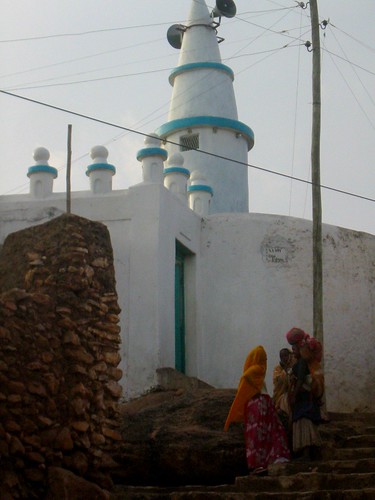
For those of your who follow developments in Ethiopia's Ogaden, I call to your attention "The Role of Religion in the Ogaden Conflict" by Mohammed Mealin Seid published on January 26, 2009. Image: Mosque inside the old city of Harar (Ethiopia), which is mentioned in the article, but is not part of the Ogaden region. The image, which is licensed under creative commons, comes from flickr user Ahron de Leeuw. Link.

Thursday, July 2, 2009

Follow up on June 11 post

It is now clear that my June 9 meeting with Salahdin Abdurahman Maow and Abdiwali Hussein Gas stirred up a lot of controversy among Ogadenis around the world. Isn't that one of the goals of a blog? In any event, I appreciate your different points of view. It is now obvious, however, that there are AT LEAST two ONLF factions even if some of you are not prepared to acknowledge that fact. Let me be clear on one other point. I meet with persons having widely divergent views in order to gain a better understanding of the issue, not because I necessarily support any particular group.

Thursday, June 11, 2009

Meeting with Ogadeni National Liberation Front delegation

In an effort to stay informed about developments in the Ethiopian Ogaden, also known as Somali Region, I met in Washington on June 9 with representatives of one wing of the Ogaden National Liberation Front (ONLF). They were Salahdin Abdurahman Maow, chairman of the Supreme Council of the ONLF, and Abdiwali Hussein Gas, director of social and diaspora affairs. The meeting was cordial and informative for me. See the picture below. Earlier this year, a number of leaders broke away from the original ONLF which has been led for many years by Chairman Mohamed Osman. (For the sake of full disclosure, I should note that I met in Washington on September 10, 2007, with Mohamed Osman and several of his lieutenants.) Osman continues to serve as chairman of the original ONLF organization. The new wing of the ONLF said that the failure of Mohamed Osman to hold a party conference and allow the election of new leadership caused it to break with the organization. The ultimate goal of the new wing, like that of the Mohamed Osman wing, is the eventual independence of the Ogaden from Ethiopia. I will leave to Chairman Maow and his colleagues to explain the positions of their wing of the ONLF. I want to use the occasion of this meeting, however, to make clear my own position concerning the Ogaden. I do not, of course, necessarily speak for the U.S. government. While I am sympathetic to legitimate Somali grievances in Somali Region of Ethiopia, I do not support independence of the Ogaden. Such a development would constitute the first step in the break up of Ethiopia as it is known today. I do not think such a development is in the interest of the United States. The only way to end continuing pressures by the ONLF and others to try to detach the Ogaden from Ethiopia is for Ethiopia to deal more effectively with Somali grievances throughout the region. While some Somalis will never be satisfied with Ethiopia’s efforts, I believe a majority could be convinced that it is in their interest to remain as part of Ethiopia if there was more local autonomy and a more serious effort by the Ethiopian government to develop the region. An Ethiopian response based largely on a military presence and reaction is not the answer. UPDATE: Pictures from the meeting are also posted on this site, maintained by Bartamaha Media.