Showing posts with label economic crisis. Show all posts

Thursday, April 10, 2025

The Spillover of Sudan's War into Eastern Chad

 The International Crisis Group posted on 10 April 2025 a 7-minute video in French (with English subtitles) titled "The Spillover of Sudan's War into Eastern Chad" by Charles Bouessel.

The video is accompanied by a photo essay by Charles Bouessel with commentary in English.

The one million refugees from Sudan are placing an immense strain on Chad's isolated and impoverished eastern provinces.  The population of one of the provinces has increased by 60 percent over the past two years.  

Friday, September 23, 2022

Is Sudan Destined to Be a Failed State?

 World Politics Review published on 23 September 2022 an analysis titled "Sudan's Stalled 'Transition' Could Create a Failed State" by Yasir Zaidan, National University of Sudan.  

Sudan is facing institutional paralysis, an economic crisis, and deepening sociopolitical tensions that risk the result of a failed state.  

Tuesday, February 26, 2019

Crisis in Sudan Grows

The International Crisis Group published on 26 February 2019 a statement titled "Bashir Moves Sudan to Dangerous New Ground."

The statement argues that President Omar al-Bashir's declaration of a state of emergency will not save his unpopular regime. It urges Bashir to step down so all sides can work to create a broadly inclusive transitional government.

Thursday, January 10, 2019

Sudan's Popular Protest

Foreign Policy published on 9 January 2019 a commentary titled "This Is the Uprising Sudan's Genocidal Dictator Always Feared" by Nesrine Malik, a Sudanese columnist based in London.

The author concludes that while there is no obvious alternative to the continued rule of President Omar al-Bashir, the regime is also out of options.

Wednesday, October 7, 2015

Impact of Chinese and Western Economic Crises on Africa

The Centre for Chinese Studies at Stellenbosch University published on 23 September 2015 a commentary titled "Stability through Crisis: Chinese Neoliberal Development Practices Promote Sustainability and Security for Africa?" by Liam O'Brien, a PhD candidate at St. Andrews in the UK.

The author argues that the recent economic downturn in China will not reduce China's support for African nations, rather it will continue.  The author may be right; time will tell.  Certainly the dollar value of China-Africa trade has decreased because of lower commodity prices and possibly due to lower Chinese demand for African commodities.

The author goes on to argue that the impact of the economic problems in China contrast with those of Africa's traditional partners (Europe and the United States), which took to withdrawing their commitments following the economic crisis of 2008.  His evidence for this conclusion is confined to the situation in South Africa and, seemingly, only the withdrawal of UK development finance to South Africa.

South Africa does not represent all of Africa and the UK does not represent the entire West. While there may have been a brief interruption in Western investment in and financial support for Africa, the evidence suggests the relationship has largely returned to normal.  For example, cumulative Western investment and annual investment flows far exceed China's cumulative and annual FDI flows in Africa.  

Wednesday, August 24, 2011

"More U.S. Businesses Encouraged to Look At Africa's Potential"

Photo: VOA - N. Colombant
I'm quoted in Nico Colombant's Aug. 18 Voice of America story on U.S. investment in Africa:
Development experts say smaller companies which have something to offer for Africa's growing middle class and infrastructure needs should also take a close look. A former U.S. ambassador in Africa, David Shinn, says the U.S. government should do more to help nervous companies take their first steps.

"Part of it is cajoling the American private sector, having perhaps a major conference led by the Secretary of State or the Secretary of Commerce or the president even to bring in potential investors and encouraging them to go to Africa," said Shinn.

Tuesday, July 20, 2010

Analysis of Sudan’s economic situation


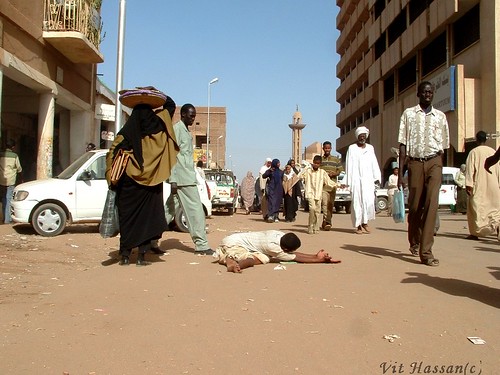
Poverty in Khartoum by Flickr user Vít Hassan, creative commons licensed.

On December 8, 2009, the United Nations Economic and Social Commission for Western Asia released an excellent report by Hassan A. Abdel Ati titled "Sudan and the International Financial Crisis: Effects and Response."

It explains that prior to the global financial crisis the Sudanese economy was one of the fastest growing in the world despite two decades of Western sanctions. Foreign direct investment was also among the highest in Africa. This rapid growth was not, however, broad-based and allowed significant disparities to continue between urban and rural areas and between regions, thus contributing to growing inequalities, increased rural-urban migration and a fast growing urban informal sector.

The international economic crisis created serious problems for Sudan. There was a huge deterioration of the productive sector and a sharp drop in foreign investment. The sharp fall in oil prices led to budgetary instability. In the meantime, Sudan continued to run up high costs for defense and security. The government’s reaction to the crisis was sluggish and disproportionate. The impact was even more severe on southern Sudan, which depends entirely on oil revenue and foreign assistance and largely uses the dollar for its currency.

Thursday, February 5, 2009

Interview with BBC Focus on Africa

BBC Focus on Africa published an interview with me as a two-page spread titled "Loaded Questions" in its January - March 2009 issue. The subheading of the article is: "What will the Obama presidency mean for Africa? Nick Ericsson finds out from an analyst and former US ambassador to the continent Professor David Shinn." BBC has not posted the article online, but there is an online forum here asking
Will Obama be a friend to Africa? Is Barack Obama likely to be a 'President for Africa'? Do you think his foreign policy will prioritise seeking the end to Africa's bloody and drawn-out conflicts? Or will the problems facing the United States prevent him from substantial commitments to his father's homeland? Could it be that President Bush and his generous aid packages have set the bar higher than Obama with his inherited tight purse strings can better?
Here's how I responded to the BBC's first question, "With strong Kenyan heritage will Barack Obama be a 'President for Africa'?"
I think initially he is going to be careful about the degree to which he engages in African issues -- because of the fact that he has this African heritage. Also there are so many other pressing issues in the United States. The economic crisis will overshadow almost everything in the initial months as well as problems aroudn the world -- Iraq and Afghanistan, North Korea, Russia, China and the Palestinian issue. It is not realistic to expect that he will focus on Africa immediately.

Monday, January 12, 2009

African expectations of Obama's policy

I interviewed with Oromo-language service of the Voice of America today by phone. In the interview, which will be translated into Oromo and run in English and Oromo on February 14, I discussed the Obama administration and African expectations of his policy. I made the following points among others: Africans may have expectations that are two high concerning the new administration. The new president must focus on the economic crisis facing the United States and even more pressing foreign policy issues in Iraq, Afghanistan, Israel-Palestine, Iran, North Korea, etc. It is unrealistic to expect the president to engage personally on most African issues during his first year in office. He will, of course, delegate this responsibility to others and eventually he will almost certainly engage on the continent. It is also important to remember that the Bush administration trebled the amount of financial resources going to Africa. In view of America's economic problems, it will be difficult to maintain this level, not to mention increase it. The Obama administration will probably give more support to those leaders who are serious about democratization, improving the human rights situation, reducing corruption, and improving governance. I believe there will also be increased attention to the environment whether it be combating global warming or reducing deforestation and soil erosion. When asked to compare Barack Obama and Martin Luther King, I suggested that they both had extraordinary oratorical skills. More important, they both had a vision on how to make the United States a better country. A majority of American voters from different racial and socio-economic backgrounds decided to try this new vision.