Showing posts with label Haile Selassie. Show all posts

Monday, December 15, 2025

Myths and Modern Ethiopia

 Ethiopia Insight published on 15 December 2025 a commentary titled "Medieval Myths to Modern Ethiopia" by Muktar Ismail.

The author disputes the myth of the Solomonic dynasty.  He concludes that Ethiopia faces a critical challenge in creating a shared narrative that embraces its diverse population.  This requires moving away from its Solomonic mythology towards a more inclusive fact-based dialogue.  

Monday, December 4, 2023

Video on Ethiopia's Goal to Access the Sea

 Joseph Pisenti, an American YouTuber in Dallas, Texas, who uses the name RealLifeLore recently posted a 50-minute video titled "Why Ethiopia Is Preparing to Invade Eritrea Next."  

This is a summary of Ethiopian history, demography, religion, and ethnicity leading up to Prime Minister Abiy Ahmed's expression of the need for landlocked Ethiopia to have access to the Red Sea.  

Sunday, January 22, 2023

Ethiopian History Haunts Nation-building Efforts

 Ethiopia Insight published on 22 January 2023 a commentary titled "Ethiopian Nation-building Is Haunted by Its Troubled History" by Muktar Ismail, former advisor to the Somali Regional government and former UN staff member.

The author argues that Ethiopia has not had a history of a deliberate program to build national unity.  Internal conflicts that arose over a century ago continue to this day.  The wars in Tigray and Oromia are examples of this history.  Ethiopia needs to launch a transitional justice and reconciliation process with the aim to end its culture of impunity around past and present abuses.  

Tuesday, December 21, 2021

Ethiopian Political Developments Since World War II

 A Reuters Special Report published on 21 December 2021 is an account titled "A Fractured Giant: Ethiopia's Struggle to Build a Nation" by Matthew Green.

This is a review of political developments in Ethiopia since World War II, supplemented with photographs during the different periods.

Wednesday, March 11, 2020

Ethiopia: 1977 Expulsion of Americans from Kagnew Station and Consulate General in Asmara

The Association for Diplomatic Studies and Training recently posted an account titled "Leaving with Their Heads Held High--The U.S. Expulsion from Eritrea, 1977." This is an oral history account of the 1977 demand by Ethiopian leader Mengistu Haile Mariam to close within four days the highly classified U.S. communications station known as Kagnew and the U.S. Consulate General in Asmara. It relies on the recollections of Keith Wauchope, who was in charge of the Consulate General at the time. This occurred at the height of the Cold War and a low point in U.S. relations with Ethiopia.

Saturday, April 19, 2014

New Book about Haile Selassie and Ethiopian Diplomacy

Tadias Magazine did a brief review of a new book titled Black Ethiopia: A Glimpse into African Diplomacy, 1956-1991 by Belete Belachew Yihun.  Published by Tsehai Publishers, it deals with the diplomatic legacy of Haile Selassie.

Thursday, March 27, 2014

Ethiopia: Ras Tafari Symposium in Addis Ababa

The Council for the Development of Social Science Research in Africa (CODESRIA) is organizing a symposium in Addis Ababa on 24-25 May titled "Ras Tafari: The Majesty and the Movement."  The call for papers emphasizes the historical role of Emperor Haile Selassie and the Rastafari Movement that developed around him. 

Saturday, December 28, 2013

International Journal of Ethiopian Studies

The 2013 issue of the International Journal of Ethiopian Studies is now available.  It contains the following articles:
  • The Dichotomy between Reality and Rhetoric in African Politics: Placing Ethiopia in the 'Continental' Pan-African Movement by Belete Belachew Yihun.
  • Critical Reflections on an Oromo Aphorism and Emancipation by Maimire Mennasemay.
  • The Politics of the Imposed and Negotiation of the Emerging Nile Basin Regime by Aaron Tesfaye.
  • The Quest for Equitable Resolution of the Nile Waters Dispute: Wandering in the Wilderness? by Dereje Zeleke Mekonnen.
  • Politics and Religion in Haile Selassie's Ethiopia: Apogee and Crisis of a Confessional African State (1916-1974) by Paolo Borruso.
You can order a copy for $25 by going to the Tsehai Publishers website at www.ijes.tsehaipublishers.comwww.ijes.tsehaipublishers.com.

Wednesday, November 27, 2013

Tafari Wossen's Feudal Childhood

The Rift Valley Institute published on 16 September 2013 a brief personal biography by Tafari Wossen, an Ethiopian journalist and founding editor of the Seven-Day Update, a weekly news review published in Addis Ababa.  The focus of the biography is his early childhood during the imperial and Derg governments.  

Sunday, November 28, 2010

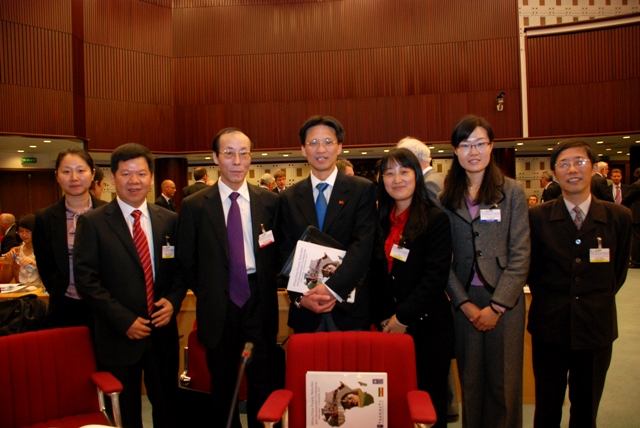
Ethiopia-China 40th anniversary of relations


Image: Vice Minister Zheng Wenkai of China with his delegation and staff from UNDP China office at the Africa-China Poverty Reduction and Development Conference (Addis Ababa, Ethiopia 1-2 November 2010). Credit, creative commons licensed on Flickr by United Nations Development Programme.

The Voice of America Horn of Africa service (Amharic, Tigrinya and Afan Oromo) asked me to comment on Nov. 24 on the 40th anniversary of the establishment of diplomatic relations between Ethiopia and China.

I noted that Emperor Haile Selassie established the relationship 40 years ago with the blessing of the United States, which was itself in the process of improving ties with China.

Ethiopia-China ties experienced a setback after Mengistu Haile Mariam took power in 1974 because Mengistu developed close ties with the Soviet Union at the height of the Sino-Soviet conflict. This led to cooler relations between Ethiopia and China. When the EPRDF replaced the Mengistu government in 1991, there began a significant improvement in Sino-Ethiopian ties that has continued to the present day.

Although the United States and European Union continue to have strong ties with Ethiopia, it could be argued that China has more significant economic links today with Ethiopia than either the United States or European Union.

China has made available significant low interest loans and is the major player in both road construction and developing the telecommunications network. The United States still offers more assistance, however, and all of it is grant aid.

Ethiopia’s exports to China increased from $7 million in 2002 to $81 million in 2008. On the other hand, its imports from China increased from $145 million in 2002 to $1.15 billion in 2008. This enormous Ethiopian trade deficit with China is not sustainable.

When asked what impact China was having on democracy in Ethiopia, I replied that both China and Ethiopia have a different view of democracy than does the United States and West generally. When looked at from the standpoint of the Western view of democracy, China obviously does not encourage Ethiopia to move in that direction.