Showing posts with label Soviet Union. Show all posts

Sunday, June 1, 2025

Russia-Africa Relations

 The South African Institute of International Affairs (SAIIA) posted on 14 May 2025 a one hour televised interview titled "Why Is Russia Deepening Its Engagement with Africa?" with Steven Gruzd, SAIIA.

Following intense engagement by the Soviet Union in Africa during the Cold War, Russian interest dropped dramatically in the 1990s and and only began to return in the 21st century under the rule of Vladimir Putin.  The Wagner Group is an example of the new interest.  Russia still has a small trade and economic footprint in Africa and provides very little foreign aid.  Egypt is its most important partner.  It has developed partnerships in the nuclear power field and and remains an important source of arms for Africa.  The African countries have very little contact with the former Soviet republics.   

Monday, September 30, 2024

Russia-South Africa Relations: It's Complicated

 The South African Institute of International Affairs published on 19 September 2024 a commentary titled "Can Old Alliances Survive New Realities in Russia-South Africa Relations?" by Gustavo de Carvalho and Xiang Chen.  

Historically close ties between the Soviet Union and the anti-apartheid movement (now the government) in South Africa is encountering a younger generation of leaders who are less concerned with this legacy.  As a result, there is strategic ambiguity in South Africa's policy today vis-a-vis Russia.

Friday, September 27, 2024

Cold War Lessons for Current US Africa Policy

 War on the Rocks published on 26 September 2024 an analysis titled "Be Kennedy, Not Kissinger: What Cold War Competition in Guinea and Angola Can Teach Us about U.S. Influence in Western Africa" by Nathan Heath, National Security Innovations, Inc. 

Drawing on U.S. Cold War policy, the author argues that the Kennedy administration followed a successful strategy in Guinea while Henry Kissinger pursued an unsuccessful one in Angola.

His lessons for U.S. policy in Africa today are the importance of high-level personal engagement, the need to seize openings when adversaries make mistakes, a coherent strategy, and drawing on help from countries with regional influence.  


Thursday, May 2, 2024

Russia Repeats Soviet Tactics in Africa

 American Diplomacy posted in May 2024 a commentary titled "A New Face, But an Old Tactic: History Offers Clues on Stopping Russia's African Advance" by Herman J. Cohen, former U.S. Assistant Secretary of State for African Affairs.

Russia offers military support to unstable regimes across Africa, helping them retain power in exchange for diplomatic allegiance and natural resources.  This is essentially a continuation of Soviet-era Africa policy.  

While authoritarian leaders such as the head of the Central African Republic secure their positions with Wagner Group support, little benefit is shared with the general population.  In the meantime, US policymakers need to stay focused on a strategy of fostering economic development.

Monday, December 4, 2023

Video on Ethiopia's Goal to Access the Sea

 Joseph Pisenti, an American YouTuber in Dallas, Texas, who uses the name RealLifeLore recently posted a 50-minute video titled "Why Ethiopia Is Preparing to Invade Eritrea Next."  

This is a summary of Ethiopian history, demography, religion, and ethnicity leading up to Prime Minister Abiy Ahmed's expression of the need for landlocked Ethiopia to have access to the Red Sea.  

Wednesday, November 29, 2023

Podcast on Great Power Competition in the Horn of Africa

 This is a two and a half hour podcast titled "Great Power Rivalry and Competition in Africa: Ramifications for the Horn of Africa" that took place on 28 November 2023 and was facilitated by the Centre for Global Governance Studies at Louvain University in Belgium.  It covered a wide range of issues concerning EU, US, Russia, China and middle power relations with Ethiopia, Sudan, Somalia, Djibouti, Eritrea, and Kenya. 

Uoldelul Chelati Dirar, University of Macerata in Italy, and Harry Post, University of Exeter, chaired the podcast.  Panelists included: Annette Weber, EU Special Rapporteur for the Horn of Africa; Lauren Johnston, University of Sydney; David Shinn, George Washington University; Wogene Teshome, Center for Dialogue, Research and Cooperation; Kalewongel Minale, Ethiopian Civil Society Organizations Council; and Fisseha-Tsion Menghistu, Ethiopian Civil Service University.  

Thursday, August 31, 2023

Combatting Russian Disinformation in Africa

 The Foreign Policy Research Institute published on 29 August 2023 a commentary titled "Russian Disinformation in Africa: No Door on this Barn" by Dan Whitman.

Russia has a long history of effective disinformation in Africa while Western governments search in vain for a way to counter the lies.  The author suggests it is time to support financially certain NGOs and independent citizen organizations that target Russian disinformation.  

Saturday, August 13, 2022

Challenges for People's Liberation Army to Obtain Access to the Indian Ocean Region

 The Strategic Studies Institute of the US Army War College Press published in July 2022 an edited volume titled Enabling a More Externally Focused and Operational PLA  that contains a chapter (#4, pp. 67-87) titled "The People's Liberation Army and Operational Access in the Indian Ocean Region: Geographic Constraints and Lessons from the Cold War" by David Brewster.  

The chapter examines challenges faced by the People's Liberation Army in obtaining operational access to the Indian Ocean region.  It focuses on how China's strategic imperatives may drive the army's future presence, bearing in mind the geographic constraints particular to the region and the Soviet experience during the Cold War.  

Wednesday, June 8, 2022

Putin's War: Africans Care But Who Cares about Their Opinion?

 KT Press published on 6 June 2022 a commentary titled "War on Ukraine: Africa May Care But Who Cares for Its Opinion?" by Vincent Gasana, African journalist.

In a provocative commentary, the author concludes that Africans are not turning a blind eye to Putin's invasion of Ukraine.  Rather, they are watching helplessly, knowing their opinion will not count.  

Thursday, January 20, 2022

China, Africa, and Elements of the Cold War

 World Politics Review published on 19 January 2022 a commentary titled "China's Engagement with Africa Has a Cold War Parallel" by Howard W. French.  

The author concludes it is remarkable how similar, if not identical, some of China's interaction with Africa has been to that of the Soviet Union during the Cold War.  This includes a stiff learning curve and a lot of mistakes along the way.  

Wednesday, June 30, 2021

The Case Against Ethiopia's Ethnic Federalism

 Ethiopia Insight posted on 30 June 2021 a commentary titled "Ethnic Federalism: A Theory Threatening to Kill Ethiopia" by Kassahun Melesse, Oregon State University.  

The author argues that ethnic federalism has been a major barrier to national unity and common public institutions. Ethiopia must move away from its Soviet-inspired ethnic federalism to achieve peace, prosperity and democracy.  

Wednesday, July 1, 2020

Somalia and Somaliland: American Diplomats Recall Oral History

The Association for Diplomatic Studies and Training posted a piece titled "Somalia--From Great Hope to Failed State" based on the oral history of five American diplomats dating back to 1960.  Two are former ambassadors, two embassy officers, and one based in Washington during the international intervention in Somalia from 1992 to 1993.  These are the recollections of the officers a number of years after they served in Somalia. 

Wednesday, March 11, 2020

Ethiopia: 1977 Expulsion of Americans from Kagnew Station and Consulate General in Asmara

The Association for Diplomatic Studies and Training recently posted an account titled "Leaving with Their Heads Held High--The U.S. Expulsion from Eritrea, 1977." This is an oral history account of the 1977 demand by Ethiopian leader Mengistu Haile Mariam to close within four days the highly classified U.S. communications station known as Kagnew and the U.S. Consulate General in Asmara. It relies on the recollections of Keith Wauchope, who was in charge of the Consulate General at the time. This occurred at the height of the Cold War and a low point in U.S. relations with Ethiopia.

Monday, November 18, 2019

Russia, Africa, Arms, and Debt

Eurasia Review posted on 18 November 2019 a commentary titled "Russia, Africa and the Debts" by Kester Kenn Klomegah, independent researcher on Russia and Africa.

At the Russia-Africa summit in Sochi in late October, President Valdimir Putin reiterated a commitment made early this century that Russia had cancelled more than $20 billion in African debt accrued during the Cold War. Most of this debt resulted from loans for the purchase of arms.

According to the Stockholm International Peace Research Institute, between 2014 and 2018 Russia accounted for 49 percent of arms transfered to North Africa and 28 percent to Sub-Saharan Africa. Russia was the largest single source of arms for both regions. Russia's state arms exporter announced at the Russia-Africa summit in Sochi that Russia plans to transfer $4 billion worth of weapons to African countries in 2019, according to an article in the 24 October 2019 The Moscow Times. This raises the question whether African countries are accruing new debt or Russia is insisting on other terms before it transfers arms. There is some evidence that arms are being bartered for mining rights as reported by Eric Schmitt in an article tilted "Russia's Military Mission Creep Advances to a New Front: Africa" in The New York Times on 31 March 2019.

Sunday, April 2, 2017

Interview on China-Africa and Other Issues

WUCF TV in Orlando, Florida aired on 2 April 2017 a 25 minute interview with me on its "Global Perspectives" program with John Bersia that dealt with China-Africa issues, the U.S. Foreign Service, and Africa generally.

Friday, October 7, 2016

Ethiopia: Looking Back on the Overthrow of Emperor Haile Selassie

The Association for Diplomatic Studies and Training at the Foreign Service Institute outside Washington published in October 2016 the oral history accounts of several American diplomats who served at the U.S. embassy in Addis Ababa in the period before and after the overthrow of Emperor Haile Selassie in 1974. The accounts are titled "Anatomy of an Overthrow: Why a Revered African Leader Was Toppled."

Sunday, November 28, 2010

Ethiopia-China 40th anniversary of relations


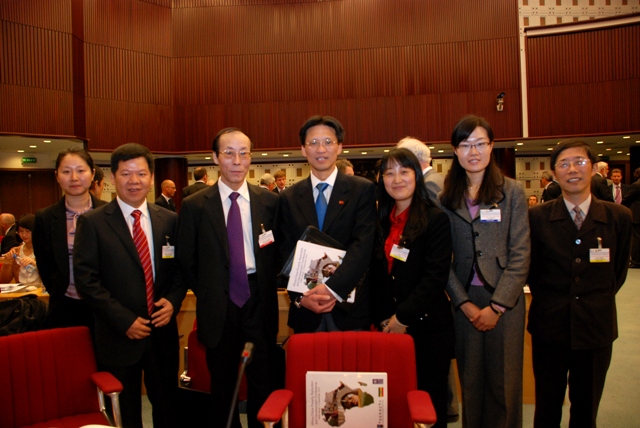
Image: Vice Minister Zheng Wenkai of China with his delegation and staff from UNDP China office at the Africa-China Poverty Reduction and Development Conference (Addis Ababa, Ethiopia 1-2 November 2010). Credit, creative commons licensed on Flickr by United Nations Development Programme.

The Voice of America Horn of Africa service (Amharic, Tigrinya and Afan Oromo) asked me to comment on Nov. 24 on the 40th anniversary of the establishment of diplomatic relations between Ethiopia and China.

I noted that Emperor Haile Selassie established the relationship 40 years ago with the blessing of the United States, which was itself in the process of improving ties with China.

Ethiopia-China ties experienced a setback after Mengistu Haile Mariam took power in 1974 because Mengistu developed close ties with the Soviet Union at the height of the Sino-Soviet conflict. This led to cooler relations between Ethiopia and China. When the EPRDF replaced the Mengistu government in 1991, there began a significant improvement in Sino-Ethiopian ties that has continued to the present day.

Although the United States and European Union continue to have strong ties with Ethiopia, it could be argued that China has more significant economic links today with Ethiopia than either the United States or European Union.

China has made available significant low interest loans and is the major player in both road construction and developing the telecommunications network. The United States still offers more assistance, however, and all of it is grant aid.

Ethiopia’s exports to China increased from $7 million in 2002 to $81 million in 2008. On the other hand, its imports from China increased from $145 million in 2002 to $1.15 billion in 2008. This enormous Ethiopian trade deficit with China is not sustainable.

When asked what impact China was having on democracy in Ethiopia, I replied that both China and Ethiopia have a different view of democracy than does the United States and West generally. When looked at from the standpoint of the Western view of democracy, China obviously does not encourage Ethiopia to move in that direction.